The short answer
Answer one question per heading with the answer in the first sentence, cite real sources and link them, put a named author on every article, and let the AI crawlers through. Those four changes are what the engines cite, and each one is ordinary good SEO as well.
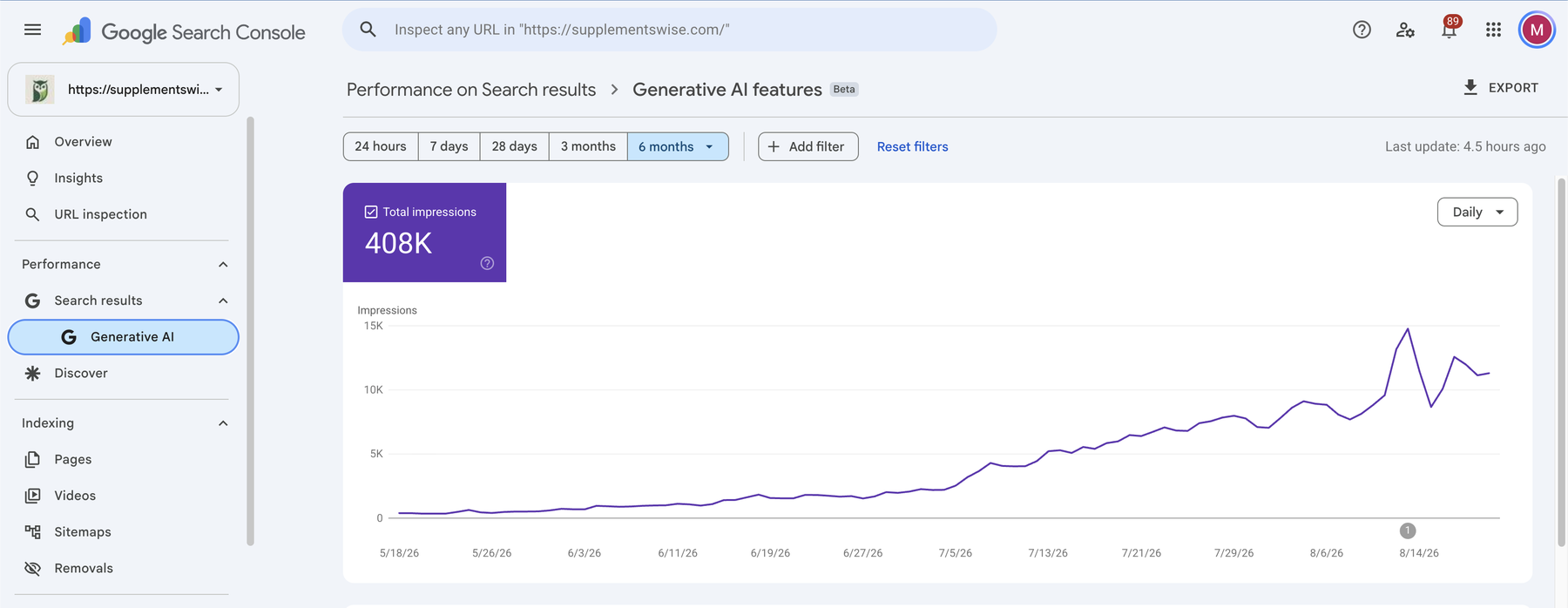
In May 2026 Google Search Console quietly added a report called “performance in generative AI features”: how often your pages appear inside AI Overviews and AI Mode answers. For one Shopify store we run, that number went from about 425 impressions a day when the report began to about 11,000 a day by late August, with 97% of those impressions landing on blog articles rather than product pages. The full numbers are in the case study.
This guide is what we changed during that window and what the research on AI citation says, organised so you can do it on your own store. It is honest about correlation: several things changed at once, and nobody outside Google and OpenAI knows their ranking functions. But the pattern is consistent across the engines, and it is the same pattern classic SEO has rewarded for years.
What AI answer engines actually cite
Across ChatGPT search, Perplexity, Google’s AI Overviews and AI Mode, the pages that get cited share four properties. They answer a specific question directly, usually in the first sentence or two under a heading. They are structured so a machine can lift a passage: a question heading, a concise answer, then supporting detail. They show their sources, with real citations a model can verify. And they come from an identifiable entity: a named author, an organisation with a consistent footprint, a site that other sources corroborate.
Product pages rarely have any of those properties, which is why 97% of our AI impressions land on articles. A product page says “buy this”; an article says “here is the answer to your question, and here is the product that follows from it”. AI engines want the second.
Step 1: find the questions your store can answer
Do not start from a GEO keyword tool. Start from your Search Console, the same way you would for ordinary rankings: queries you already appear for, phrased as questions, at positions 5 to 20. Use the regex filter ^(how|what|why|when|which|can|does|is|should)\b in the query filter. The striking distance guide covers the workflow. Question queries are where AI engines look first, and ones you already half-rank for are the cheapest to win.
For a store, the richest seams are dosage, timing, comparison and “is X safe with Y” questions: informational intent that product pages cannot satisfy. Our most-cited articles are a dosage guide, a timing guide and a comparison, in that order.
Step 2: write answer-first, one question per heading
Structure is most of the work. For each article:
- A question-phrased H2 for every sub-question (“How long do running shoes actually last?”), not topic labels (“Product lifespan”).
- The direct answer in the first sentence under the heading, with the number, the range or the yes/no. Then the nuance. Models extract the first sentence; humans keep reading because of the nuance.
- One idea per paragraph, short paragraphs. Walls of text get skipped by both readers and extractors.
- A concise summary near the top that answers the page’s main question in two or three sentences. This is the passage most likely to be lifted.
- A FAQ section at the end for the adjacent questions that do not deserve a section. Mark it up with FAQPage schema.
This is also, not coincidentally, what wins featured snippets.
What our own data showed
Between May and August 2026 the store’s impressions in Google’s generative AI features went from about 425 a day to about 11,000, with 97% of them landing on blog articles rather than product pages. Product pages say “buy this”; articles answer the question the engine was asked.
Step 3: cite real sources and link them
Nobody outside these companies can tell you how sources are weighted, and we are not going to pretend otherwise. What we can say is that the pages of ours that get cited carry linked, checkable references, and the ones that do not, mostly do not. In a health category this is also your liability shield. Every study you reference should be checked against the actual paper and linked to it. We learned this the hard way: an early AI-assisted draft cited studies that did not exist, and catching that before customers did is why citation verification became a hard gate in our system. If you use any AI writing tool, verify every reference it produces against Crossref or PubMed before publishing. Invented citations are the single fastest way to lose trust with both readers and engines.
Step 4: become an entity, not just a domain
Engines decide who to cite partly on whether they can identify who you are. Concretely:
- An author page with a real name, a photo, credentials or experience, and links to the same person elsewhere (LinkedIn, a YouTube channel, other publications). Byline every article to that page.
- Organization schema on every page with consistent name, logo, URL and
sameAslinks to your social profiles, your YouTube channel, and any knowledge-base entries (Wikidata if you have one). - One set of structured data, not three. Shopify stores commonly ship duplicate Organization, WebSite and Product schema from the theme, an SEO app and a third source. Duplicates confuse parsers; audit with the Rich Results test and turn off the extras.
- Consistent naming across your store, your socials and your listings. The engine is trying to resolve you to one thing.
Worth knowing
Several Shopify SEO apps and theme snippets block AI crawlers by default, framed as protection. If you want citations, that protection is just invisibility. Check robots.txt for GPTBot, ClaudeBot, PerplexityBot and Google-Extended before anything else.
Step 5: let the crawlers in and tell them what you are
- robots.txt: make sure you are not blocking GPTBot, ClaudeBot, PerplexityBot, Google-Extended or Bingbot. Several Shopify SEO apps and theme snippets block AI crawlers by default “for protection”; that protection is invisibility.
- llms.txt: a plain-text file at
/llms.txtdescribing what your site is, who runs it, and your key pages. It is an emerging convention, cheap to add, and engines increasingly read it. Ours is at queryclimb.com/llms.txt if you want a template. - Server-rendered content. Shopify themes are fine here; just avoid apps that inject your article body with client-side JavaScript.
Step 6: keep it fresh and keep it linked
For anything with a time component, freshness appears to matter: our own recently updated pages get cited more often than stale ones covering the same ground. Refresh your top-cited articles quarterly: update figures, add the newest study, fix the date. And link every new article from the two or three most relevant existing pages, including the product page that used to rank for the question. Internal links are how engines discover and weight the new page; orphaned articles get cited late or never.
Measuring it
In Search Console, open Performance and look for the banner offering the generative AI features report (rolled out from May 2026). It shows impressions and clicks from AI Overviews and AI Mode by page and query. Two things to watch: the daily impression trend, and which pages carry it. If your product pages dominate, you are being cited for brand and price queries; if articles dominate, you are being cited as a source, which is the one that compounds.
Outside Google, there is no official measurement yet. The practical proxy is to ask ChatGPT, Perplexity and Gemini your top ten questions monthly and record who they cite. Tools like Surfer and Frase automate this tracking on their paid tiers if you want it at scale.
Key takeaway
Every change on this list is good classic SEO independently of AI search. That is the point: you are not betting on a channel, you are structuring content so both ranking systems and answer engines can use it.
What we cannot prove
The 425-to-11,000 curve coincided with the whole loop running on the store: new answer-first articles, a citation gate, an author page, schema de-duplication, internal-link rescue, and a GEO fix batch in August. We cannot isolate which change did what, and Google’s own rollout of the report and of AI features grew the denominator for everyone during the same months. What we can say is that every change above is also good classic SEO, costs nothing but discipline, and the store that did them saw its AI impressions rise 26-fold while its ordinary clicks rose 11-fold. QueryClimb automates the content half of that list and audits the entity half; the free tier gives you the audit score and the list of questions your store already nearly answers.
Frequently asked questions
Do AI citations send traffic, or just impressions?
Both, at a lower click rate than classic results. AI Mode and Overviews cite pages with links; some users click through, many do not. The value is split between direct clicks, brand exposure, and being the source the engine trusts next time, which compounds.
Does AI-assisted content get cited?
Yes, when it satisfies the properties above. Engines cite pages, not authorship methods. Unverified, generic AI volume does not get cited, and neither does unverified human volume.
Should I block AI crawlers to protect my content?
If you want citations, no. Blocking GPTBot and friends removes you from the engines you are trying to appear in. Block them only if you have decided AI search is not a channel for you.
How long does it take?
In our case the curve turned within four to six weeks of the structural changes and kept climbing for three months. Expect similar lag to ordinary ranking changes.