The short answer
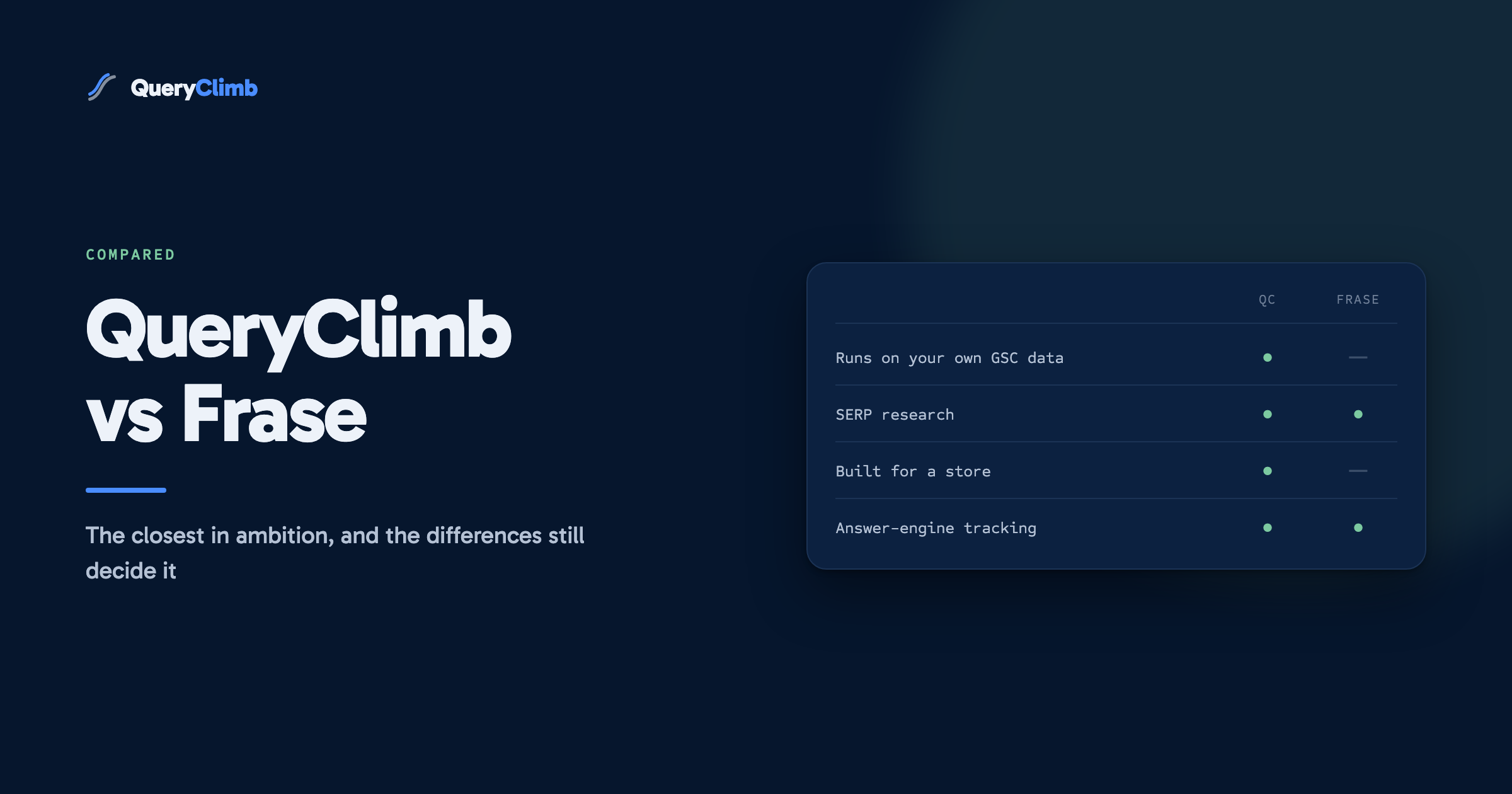
Frase is a research and writing workspace that publishes to WordPress, Webflow and Wix. QueryClimb is a loop that starts from your Search Console and publishes to Shopify. Frase is broader across platforms and teams; QueryClimb is narrower, with a cannibalisation veto, verified citations and post-publish tracking.
We make QueryClimb, so this is not a neutral review. It is an attempt at an accurate one. Frase deserves the attention because, of every tool we benchmarked, it is the closest in ambition: it also tries to cover research, drafting, a calendar and AI visibility in one product rather than owning one slice. The differences are real, though, and they decide which tool suits a Shopify store. All Frase prices were checked against frase.io/pricing on 21 August 2026.
The short version
Frase is a research-and-writing workspace: you bring a keyword, it analyses the top results, builds a brief, drafts with AI, scores the draft for SEO and GEO, and hands you content to publish on WordPress, Webflow or Wix. QueryClimb is a loop that starts from your Search Console instead of a keyword, refuses to write anything that competes with pages you already rank, publishes to Shopify on a schedule, and tracks every article afterwards. Frase is broader across CMSs and better for teams producing at volume from keyword research. QueryClimb is narrower, Shopify-first, and built around the question “what should this store publish next, based on what it already ranks for.”
Frase in detail
Frase’s core flow is brief-led. You enter a target query; it pulls the top-ranking pages, extracts headings, questions and statistics, and assembles a research brief. Its AI writer drafts against that brief, and the editor scores the draft on topic coverage (its SEO score) and, since 2025, on structure likely to get cited by AI answer engines (its GEO score). Newer tiers add AI visibility tracking: how often your domain appears in ChatGPT, Google AI and, on higher tiers, Perplexity, Claude and Gemini answers.
Verified pricing, August 2026 (monthly; annual in brackets):
| Frase tier | Price | Includes |
|---|---|---|
| Starter | $49 ($39) | 1 seat, 1 site, 10 articles/mo, 50 audit pages, publish to WordPress/Webflow/Wix, SEO + GEO scores, ChatGPT + Google AI visibility |
| Professional | $129 ($103) | 3 seats, 5 sites, 40 articles/mo, 250 audit pages, content calendar, internal linking, + Perplexity visibility; extra seats $29 |
| Scale | $299 ($239) | 5 seats, 10 domains, 100 articles/mo, 1,000 audit pages, + Claude and Gemini visibility, client reports |
Where Frase is better than QueryClimb:
- SERP-derived briefs. If your process is “research what ranks, then write to beat it”, Frase’s brief builder is excellent and we do not have an equivalent. Our drafts are structured for the query’s intent, not reverse-engineered from the current top ten.
- CMS breadth. Frase publishes to WordPress, Webflow and Wix out of the box. We publish to Shopify, with WordPress on the roadmap.
- Team and agency features. Seats, multiple sites per plan, client reports on Scale. QueryClimb is a single-operator product today; our Scale tier covers three stores, not ten domains.
- AI visibility tracking across engines. Frase tracks your appearances in five AI engines on its top tier. Our GEO feature is an audit score of how citable your site is, not a prompt-by-prompt visibility tracker.
QueryClimb in detail
The input is different and everything follows from it. Instead of a keyword you chose, QueryClimb reads your store’s Search Console and finds the queries Google already shows you for at position 5 to 20, where a ranking is half-built. Then:
- Classify: each opportunity becomes new, refresh, rewrite, leave winning, or leave fresh. Telling you what not to write is half the product.
- Preflight: before drafting, the topic is checked against every page you rank for. A new article that would compete with an existing winner is refused and turned into a refresh of that page instead. Frase Professional includes internal linking but does not veto cannibalisation before writing.
- Draft: in your brand kit’s voice, with every scientific or factual citation verified against its source via Crossref and linked. Frase does not verify citations.
- Plan the month: one click produces a cluster-structured plan (pillar plus supports) from your catalogue, existing articles and search data, with every entry preflighted. Frase’s calendar is a scheduling surface; ours generates the plan.
- Publish and watch: scheduled publishing to Shopify, as drafts for review or live, then per-article ranking trajectory with a projection.
Where QueryClimb is better than Frase: Search-Console-first topic selection, the cannibalisation veto, citation verification, native Shopify publishing, and post-publish tracking. If you run one Shopify store and nobody has time for content, those five are the product.
Worth knowing
Frase connects Search Console for its content audit, so it is not blind to your data. The difference is where the writing flow starts: in Frase you still choose the keyword, and in QueryClimb the queries you already half-rank for choose themselves.
Head to head
| Frase | QueryClimb | |
|---|---|---|
| Topic source | Keyword you choose + SERP research | Your Search Console data |
| Brief building | Strong, SERP-derived | Intent-structured, no SERP brief |
| Monthly planning | Calendar on Professional+ | Generated cluster plan, all paid tiers |
| Cannibalisation | Not prevented | Preflight veto on every draft |
| Citations | Not verified | Verified against Crossref, linked |
| Publishes to Shopify | No | Yes, scheduled |
| Publishes to WordPress/Webflow/Wix | Yes | WordPress on roadmap |
| Internal linking | Professional+ | All paid tiers, plus orphan rescue |
| After publish | Visibility tracking | Trajectory + projection per article |
| GEO | Draft score + AI visibility tracking | Site audit score, free tier included |
| Entry | $49/mo, 10 articles | Free audit; $29/mo, 8 articles |
| Comparable tiers | Professional $129, 40 articles | Growth $79, 30 articles |
The pricing nuance
On paper Frase Professional’s 40 articles a month for $129 beats Growth’s 30 articles for $79 on volume. Two things complicate that. First, Frase’s unit is a draft you still publish, link and monitor yourself; ours is a published, linked, tracked article on your store. Second, and more important for a single store: 40 articles a month is far more than most stores’ search data justifies. If your striking distance list has twelve real opportunities this month, the thirteenth article is a guess whichever tool writes it. We cap lower on purpose.
Key takeaway
Forty articles a month is more than most single stores’ search data justifies. If your striking distance list holds twelve real opportunities this month, the thirteenth article is a guess whichever tool writes it.
Which should you buy?
Frase if: you run content across several sites or CMSs, your writers want SERP-derived briefs, you need seats and client reporting, or AI visibility tracking across engines matters to you.
QueryClimb if: you run a Shopify store, you want the tool to decide what to publish from your own data rather than from keyword research, and you would rather wake up to a published post with its citations checked than to a brief. The free audit shows your striking distance list, which is the honest test of whether there is enough signal to justify either tool; the manual version of that check is in our Search Console guide.
Both: plausible for a Shopify store that also runs a WordPress content site. They do not overlap much.
What a month actually looks like with each
The feature tables hide the thing that decides which tool suits you, which is what you personally end up doing each week.
A month with Frase. You decide the topics, usually from keyword research or a content plan you already hold. For each one you build a brief, which is where Frase earns its money: the SERP analysis is fast and genuinely useful, and a writer working from a Frase brief produces a better first draft than one working from a blank page. You or your writer draft in the editor, watch the score climb, then export, paste into your CMS, add internal links, publish, and add the URL to whatever you use for rank tracking. The tool ends at the export.
A month with QueryClimb. You open the Content Calendar, click Plan next month, and read a proposal of clusters built from your catalogue and your search data, each entry already checked against your existing pages. You untick anything you disagree with. Drafts appear on the schedule you set, with citations already verified and internal links already wired, and you review each one before it goes live. The morning brief tells you what shipped and which rankings moved.
Neither of those is better in the abstract. The first suits a team with writing capacity and a topic strategy it trusts. The second suits an operator who has neither the hours nor a topic strategy, and would rather the data picked.
Frequently asked questions
Does Frase publish to Shopify?
Not natively as of August 2026; its integrations are WordPress, Webflow and Wix, with copy-and-paste for everything else.
Does QueryClimb score drafts the way Frase does?
No. We do not score against the current SERP. Our quality gates are the brand kit, the preflight, and citation verification, and our structure defaults (question headings, direct answers) are what both Google snippets and AI engines reward.
Can I use my own Search Console data in Frase?
Frase connects Search Console for its content audit and opportunity features, but its writing flow still starts from a keyword you choose. Our entire flow starts from the Search Console data.
Which is better for GEO?
Different jobs. Frase tracks where you appear in AI answers and scores drafts for citability. QueryClimb audits your site’s citability and builds the answer-first structure, verified sources and author signals that earn citations. The Shopify blog SEO guide covers what actually gets cited.