The short answer
For one store, the best Semrush alternative is usually Google Search Console, because the job most stores pay Semrush for is watching their own rankings and Search Console reports that from Google's own data for free. Add Ahrefs Webmaster Tools and the free Screaming Frog crawler and you cover audits and backlinks too. Semrush earns its fee only when you need regular research on competitors' sites you do not own.
Semrush is a good product with a price built for agencies. The entry plan on its pricing page showed £113 a month on monthly billing when we checked it from the UK on 18 September 2026, and the plans climb from there. For an agency running forty client sites that is cheap. For one store selling waterproof jackets and hiking kit, it is often the biggest software line after Shopify itself, and most of what it gets used for is available free.
The usual “Semrush alternatives” article lists fifteen tools in no particular order. A store owner does not need an alternative to Semrush. They need an alternative for the three or four things they open it to do, so this guide sorts by job and says, for each, whether you need to pay at all.
What is the best Semrush alternative for a single store?
For most single stores the best alternative is Google Search Console, because the job they are really paying Semrush for is tracking how their own pages rank, and Search Console reports that directly from Google for free. Semrush estimates your rankings by checking a sample of results. Search Console records every query Google showed your pages for, with impressions, clicks and average position. Google describes it in its own getting started guide as a tool to help anyone with a website understand how they perform on Google Search.
That does not make Search Console a complete replacement. It sees only your own site, it caps exports, and its keyword ideas are limited to queries you already appear for. But for a store whose main question is “what is Google showing us for, and where can we climb”, your own data is a better answer than anyone’s estimate.
What do stores actually use Semrush for?
In our experience of running a store and talking to other owners, a subscription gets opened for five jobs, in roughly this order of frequency:
- Checking where the store ranks for its target queries.
- Finding keyword ideas for new guides and collection pages.
- Running a site audit to find broken links, missing titles and redirect chains.
- Looking at backlinks, usually after a ranking drop.
- Looking at what a competitor ranks for.
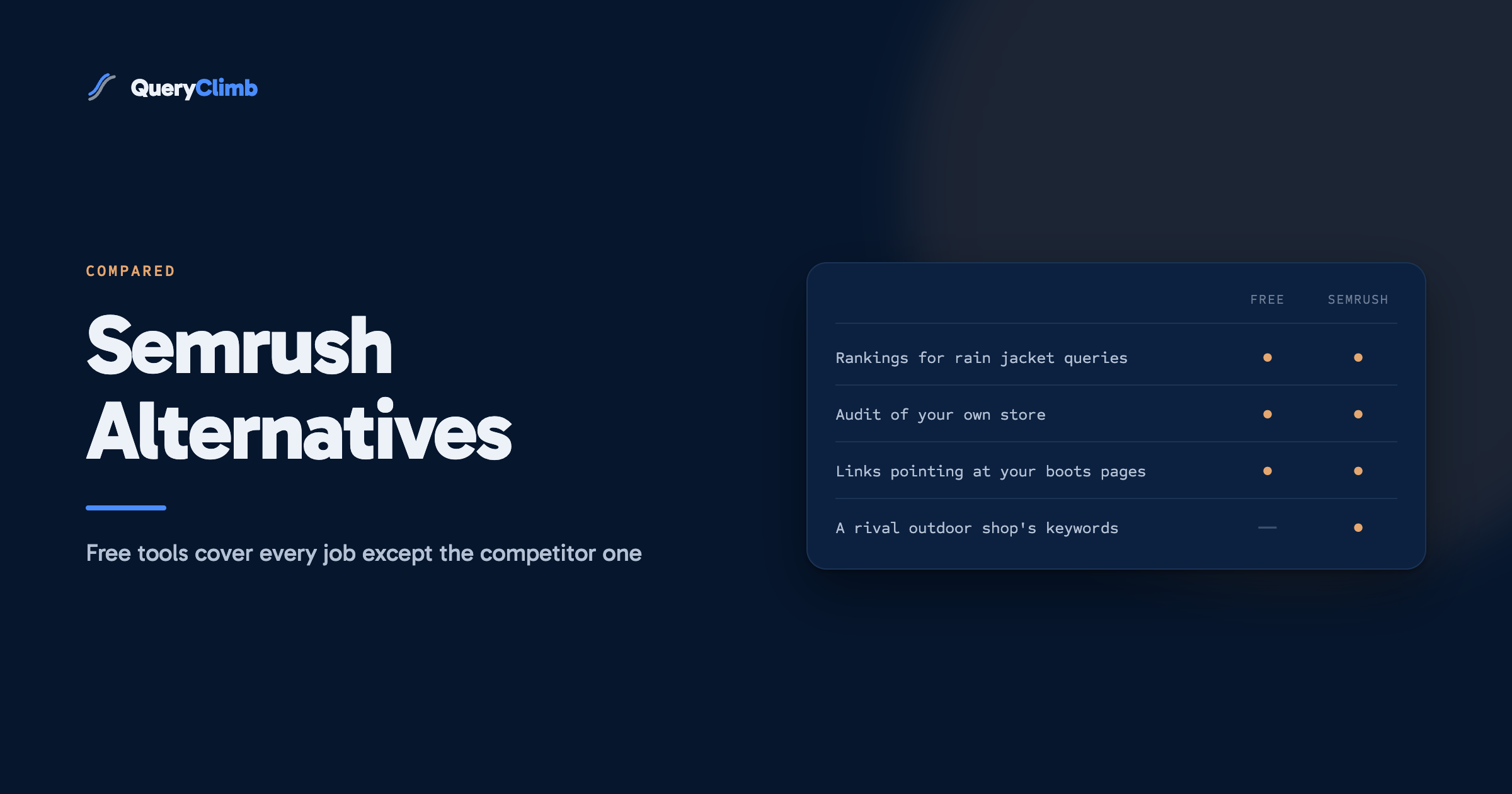
The first three are about your own site. Google, Bing and a free crawler cover them. The fourth is partly covered free. Only the fifth genuinely needs a third-party index of the whole web, because it is the only one about a site you do not own.
Be honest about which of these you did last month. If the answer is “mostly job one”, you are paying agency prices for a rank tracker.
Worth knowing
Third-party ranking and volume figures are estimates built from sampled results and clickstream data. They are useful for comparing two keywords with each other and poor at telling you what your own page earns. When Semrush says you rank 7 for “waterproof jacket for hiking” and Search Console says 12, trust the one that came from Google.
Is there a free alternative to Semrush?
Yes. Four free tools cover the jobs about your own site, and between them they replace most of what a store uses a paid suite for.
Google Search Console handles rank tracking and much of keyword discovery. The Performance report lists every query your pages earned impressions for, and filtering by position shows the queries you nearly rank for. A hiking store might find its “how to reproof a waterproof jacket” guide sitting at position 14 with steady impressions. That is a stronger brief than any volume estimate, because Google has already decided the page is relevant. Our guide to striking distance keywords walks through the filters.
Ahrefs Webmaster Tools is Ahrefs’ free tier for sites you can verify. Its own page lists a site audit that checks for more than 170 technical and on-page issues and a Site Explorer view of your organic keywords and backlinks. For a store, that covers the audit and the backlink check without a subscription. The limit is that it only works on sites you own and verify, so it will not show you a competitor.
Screaming Frog SEO Spider is the desktop crawler most SEO people learned on. Its pricing page lists a free version that crawls up to 500 URLs, with the paid licence at £199 a year. A store with a few dozen products and a few hundred blog posts and collection pages fits under the free cap, or close to it. It finds broken links, redirect chains, missing titles and duplicate descriptions, which is most of what a site audit report shows.
Bing Webmaster Tools is Microsoft’s equivalent of Search Console. It can import your Search Console verification, adds its own keyword research and site scan, and shows Bing’s view of your store. It takes ten minutes to set up once Search Console is in place, and it is the only way to see how the second search index treats your pages.
What none of these gives you is a look at a competitor’s site. That is the one gap.
Which Semrush alternative is best for keyword research?
For a store, the best keyword research tool is the query list in your own Search Console, followed by Google’s Keyword Planner for volumes, and only then a paid tool. That order matters because most keyword research on paid tools produces lists of phrases your store has no chance of ranking for.
A hiking kit store opening a paid tool and typing “waterproof jacket” gets hundreds of variants back, ranked by volume. The top ones belong to large retailers and publishers. The useful ones for a small store are the long, specific queries: “how to wash a gore-tex jacket”, “why does my waterproof jacket wet out”, “best jacket for scottish hill walking”. Search Console surfaces those for free, because it shows the long-tail queries your existing pages already appear for.
Google’s Keyword Planner is free with a Google Ads account and gives volume ranges for any phrase. The ranges are broad unless you run ads, but broad is fine when the question is “does anyone search this at all”.
A paid tool earns its place when you plan a new category from scratch. A hiking store about to add climbing gear has no Search Console data for climbing queries to read. That is a real use, and a job for a one-month subscription.
Which Semrush alternative is cheapest for rank tracking?
Search Console is the cheapest, at nothing, and for most stores it is enough. If you want daily position checks for a fixed list of queries, SE Ranking is the paid tool we would look at first, because its entry plan is priced for small sites rather than agencies.
SE Ranking’s pricing page showed its Core plan at £76 a month on monthly billing when we checked, with 2,000 keywords tracked daily. That is cheaper than Semrush’s entry plan and tracks more keywords. Semrush’s pricing page listed 500 tracked keywords on the entry tier on the same day. Prices on both pages vary by region and change often, so read them on the day you decide.
The case for a paid rank tracker is narrower than it looks. Search Console averages position across every search that showed your page, noisy for a day but sound over a month. A rank tracker checks one results page from one location once a day. Where it genuinely helps is watching a competitor’s position on the same query, which Search Console cannot do.
What the data showed us
At Supplements Wise, clicks went from 1,037 in the quarter from 21 February to 20 May 2026 to 11,697 in the following quarter, with 88% of clicks landing on blog articles. The briefs for those articles came from our own Search Console query data. The case study sets out the timeline and the caveats, including that content volume grew over the same period.
Is Ahrefs a better alternative to Semrush?
For a store, the paid Ahrefs and Semrush suites are close enough that switching between them rarely changes much. Both are most useful for researching sites you do not own, so moving from one to the other swaps the logo on a bill you may not need. The useful comparison is Ahrefs’ free tier against Semrush’s paid one: if your usage is about your own site, Ahrefs Webmaster Tools plus Search Console replaces the paid suite.
When is Semrush actually worth paying for?
Semrush is worth paying for when you need to see inside sites you do not own, the one job the free tools cannot do. Three situations justify it for a store:
- You are entering a new category. The hiking store adding climbing gear has no Search Console history for climbing queries. Seeing what the established climbing retailers rank for, and which of their guides pull traffic, shortens months of guessing.
- A competitor keeps outranking you and you do not know why. Looking at the pages they rank with, and the links pointing at them, is a competitor question.
- You are reviewing an agency’s work. A monthly subscription lets you check claims against an independent index.
All three are episodic. They happen for a month, not every month. Which means the sensible way to use Semrush as a single store is to subscribe for the month you need it, do the research properly, write it down, and cancel. Both Semrush and SE Ranking offer monthly billing, so nothing locks you into the annual rate.
What is not worth paying for is the dashboard you open on Monday mornings to feel informed. If a subscription is not changing what you publish or fix, it is a reporting cost.
Key takeaway
List the jobs you used Semrush for last month. Every job about your own site has a free replacement: Search Console for rankings and queries, Ahrefs Webmaster Tools or Screaming Frog for audits and backlinks. Keep a paid suite only for competitor research, and buy it by the month when that research is needed.
How do you replace Semrush without losing anything?
Set up the free tools first, run them alongside Semrush for one billing cycle, then cancel. That order means nothing gets lost in the gap.
A practical sequence for the hiking store:
- Verify the store in Search Console using the Domain property, and in Bing Webmaster Tools by importing from Search Console.
- Export the tracked keyword list from Semrush before cancelling. It is your record of what you cared about, and you can check each query in Search Console.
- Verify the store in Ahrefs Webmaster Tools and run its site audit. Compare the issues with Semrush’s last audit. Most will overlap.
- Crawl the store with the free Screaming Frog version and save the crawl, so you have a baseline to compare against next quarter.
- Keep one sheet of the queries that matter, with the Search Console position for each, and update it monthly.
That last step is the manual version of what a rank tracker does. It takes an hour or two a month once the sheet exists. It is also the part of the job we built QueryClimb’s Search Insights to do: it reads your own Search Console data, finds the striking distance queries, flags cannibalisation and watches rank drops, then feeds the gaps into a content calendar. Everything it does, you can do with Search Console and a spreadsheet. What it saves is the hours, and whether that is worth the price depends on how you value your time. The Shopify blog SEO guide covers the full weekly loop either way.
What you lose by leaving Semrush is competitor visibility. If you need it twice a year, two monthly subscriptions cost far less than twelve.
Frequently asked questions
Is there a completely free alternative to Semrush?
No single free tool replaces all of Semrush, but a combination covers almost everything a single store uses it for. Google Search Console handles rankings and query data, Ahrefs Webmaster Tools and the free Screaming Frog crawler handle audits and backlinks, and Keyword Planner handles volumes. The gap is competitor research, which needs a paid index.
What is cheaper than Semrush for a small business?
SE Ranking’s entry plan was priced below Semrush’s when we checked both vendors’ pricing pages in September 2026, and it tracked more keywords. For a small store, the cheaper option is often to stop paying for a suite and use Search Console, then take out a paid subscription for a single month when competitor research is needed.
Can I use Semrush for free?
Semrush offers a seven-day free trial on its paid plans, according to its pricing page. A trial is enough for one focused piece of competitor research if you plan the questions before starting it.
Do I need a paid SEO tool to rank a Shopify store?
No. Stores rank by publishing pages that answer what their customers search, linking those pages sensibly, and fixing technical problems when they appear. Every step of that can be run from Search Console, a crawler and a spreadsheet. Paid tools speed up research; they do not do the ranking.