The short answer
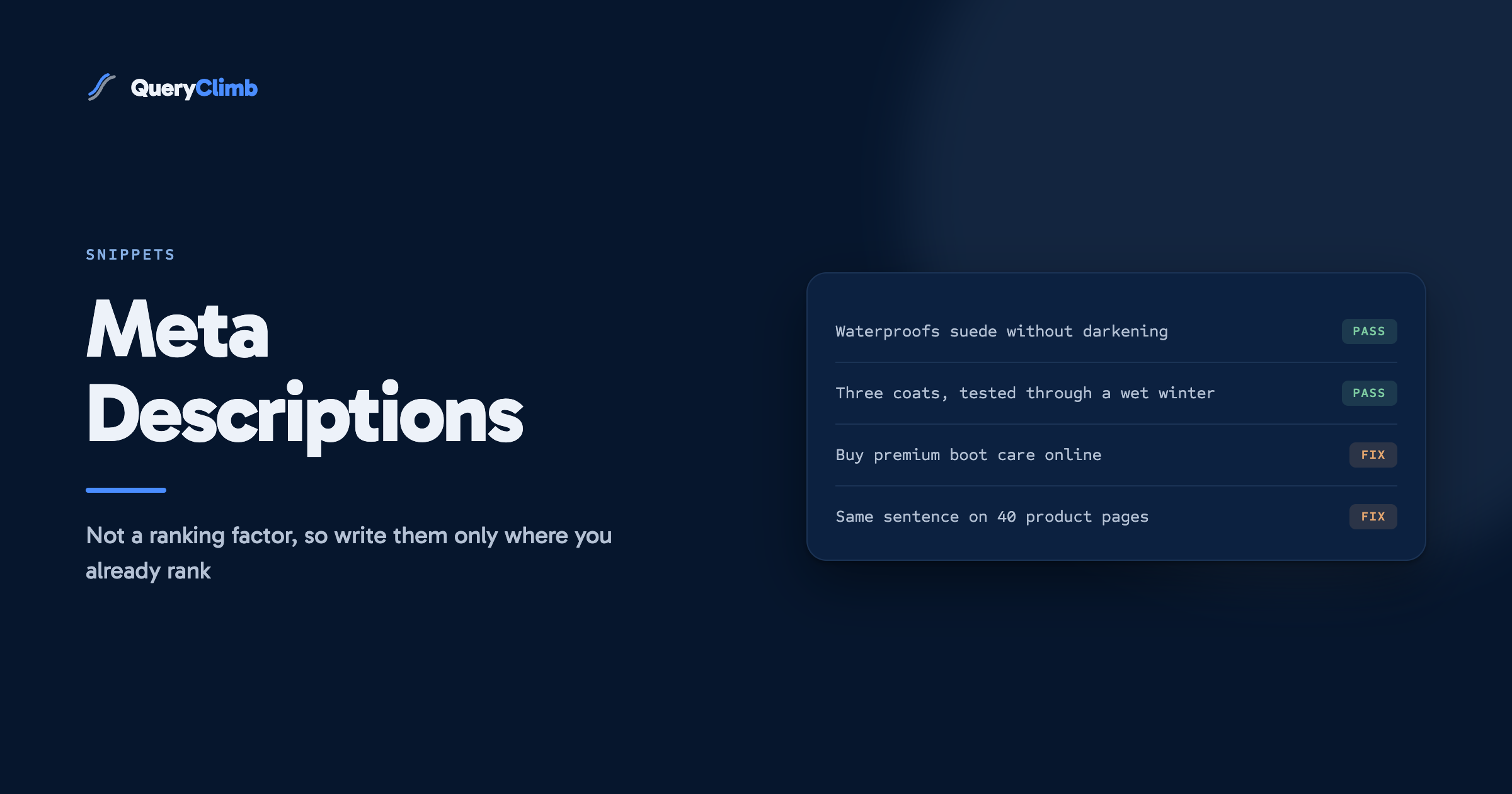
A meta description is not a ranking factor and Google frequently replaces it with its own snippet, so writing one for every page is wasted time. Write them for the pages already ranking on page one, where a better snippet converts impressions you have already earned into clicks.
Meta descriptions are the most over-taught and under-targeted job in Shopify SEO. Every checklist tells you to write one for every page. Almost none mention that Google is free to ignore what you wrote, that the tag has not been a ranking factor for many years, or that a store with 400 products has better things to do than fill 400 boxes.
The useful version of the job is narrower and more profitable. Write meta descriptions for pages that already appear in search results, where the snippet is the only thing between an impression you have earned and a click you have not. Everywhere else, let Google generate it.
This guide covers where the field lives in Shopify, what it influences, worked examples for each page type, and how to tell afterwards whether the rewrite did anything. The examples run through a boot care store: suede protector sprays, leather conditioners, waterproofing kits, a catalogue where the product names are dull and the queries are not.
What is a meta description on Shopify and where do you set it?
It is the sentence or two under your blue link in search results, and on Shopify you set it in the Search engine listing box at the bottom of any product, collection, page or blog post editor. Click “Edit website SEO” and you get a page title, a description and a URL handle.
Shopify writes the tag into your theme for you. Leave the box empty and most themes fall back to the resource’s own body content, so a product whose description opens “Our suede protector spray…” emits that opening as the meta description. An empty box is a default, not an error, and sometimes the default is fine.
Three places catch people out:
- The homepage is not edited from a product page. It lives in Online Store, Preferences, where the title and meta description fields sit at the top.
- Collection descriptions and meta descriptions are different fields. The collection description is body copy on the page. The meta description is the search snippet. Filling one does not fill the other.
- Blog posts have their own box, separate from the excerpt. The excerpt shows on your blog index; the meta description shows in Google.
Worth knowing
If you edit a meta description and Google still shows the old one, nothing is broken. Google re-crawls on its own schedule, and a low-priority product page can sit unvisited for weeks. Request indexing in Search Console for the handful of pages you care about, then wait.
Do meta descriptions affect Shopify SEO rankings?
No. Google has been explicit about this for over a decade, and nothing in the last few years has changed it. Keyword-stuffing the field does not move you up, and leaving it blank does not push you down.
What the tag influences is click-through rate, which is a real business number even if it is not a ranking input. Sit at position six for “how to waterproof suede boots” with 2,000 monthly impressions, and moving from a 2% click rate to a 4% one is another 40 visits a month from work you already did. That is the whole case for meta descriptions, and it is a decent one, but notice its shape: the value is proportional to impressions you already have. On a page nobody sees in search, a beautifully written snippet earns nothing.
This is why the advice to write metas for every page is backwards. It spends the same effort on your best page and your worst.
Why does Google show a different description than the one I wrote?
Because Google generates snippets per query, and it will use its own if it thinks the page contains a better answer to what this particular searcher typed. In our experience running Supplements Wise, the rewrite rate on long informational articles is high, and on product pages with a tight, specific description it is much lower.
The pattern is consistent once you watch it. Google replaces your text when:
- The query is specific and your written description is generic. Someone searching “will suede protector darken nubuck” gets served the paragraph from your article that answers it, not your 155-character summary of the whole page.
- Your description is duplicated across many pages. Twenty product pages sharing one template description is a signal that none of them was written for this page.
- Your description does not contain the query terms at all, but the page body does.
You cannot force Google to use yours, and no tag requests it. What you can do is write the best short answer to the query the page ranks for, at which point Google’s alternative and yours converge anyway. That is a better goal than winning an argument with the snippet generator.
What does a good Shopify meta description look like?
It answers the query, names the thing, and gives one reason to click that the title has not already given. Here are the four page types, written for the boot care store.
Product page. Bad: “Buy premium suede protector spray online. Fast shipping and great prices on all our products.” That could be any product in any store. Better: “Waterproofs suede and nubuck without darkening the nap. One 200ml can covers roughly four pairs, re-apply every six weeks in winter. UK next-day delivery.”
The second answers the objection the buyer actually has, does it change the colour, proves the page knows the category, and puts delivery last rather than first.
Collection page. Bad: “Shop our full range of boot care products at great prices.” Better: “Protector sprays, conditioners and brushes for suede, nubuck and full-grain leather, sorted by what your boots are made of. Includes what to use on waxed cotton.”
Collections earn clicks by promising a route through the range, not by announcing that a range exists.
Blog post. Bad: “In this article we discuss how to waterproof suede boots and everything you need to know about the process.” Better: “Spray, dry, repeat: the three-coat method that actually holds through a wet winter, plus the two products that ruined a pair of ours and why.”
The second names a method and admits a mistake, which is a reason to click that a generic title cannot give.
Homepage. Bad: “Welcome to our store. We sell high quality boot care products for all your needs.” Better: “Independent UK boot care shop. Suede, nubuck, leather and waxed cotton, with a guide for each material and honest notes on what does not work.”
What the data showed us
Across our own store’s Search Console data, the pages where a rewritten description changed anything measurable were almost all sitting between positions 3 and 10. Below position 15, impressions were too thin for a click-rate change to show up as anything but noise, however good the new copy was.
How long should a Shopify meta description be?
Aim for 140 to 160 characters. Google truncates by pixel width rather than character count and the cut-off moves, so front-load instead: the answer and the distinguishing detail inside the first 120 characters, the rest a bonus that may not be displayed. Shopify’s field shows a live count, will let you write 400 characters, and warns you about none of it.
One thing nobody mentions: read the description next to the title as one block, because that is how it appears. A title of “Suede Protector Spray | Boot Care Co” followed by a description opening “Our suede protector spray…” wastes six words repeating the title.
Which Shopify pages deserve a hand-written meta description?
The ones already earning impressions. This is the same prioritisation we apply to every other content decision, and it comes straight out of Search Console rather than out of a template.
Open the Performance report, last 28 days, and sort pages by impressions. The ones at the top with a click-through rate below your site average are the list. That is usually 15 to 40 pages on a mid-sized store, not 400, and it will include pages intuition would never have picked: an old post about drying wet boots, a collection nobody merchandises, a product page for a discontinued line.
If that filtering workflow is new to you, the striking distance keywords guide walks through the exact filters and export, and the blog SEO system puts the same signal step at the front of every content decision. Our Search Insights module runs that report continuously so the low-click-rate page-one list is standing rather than something you rebuild each month, but the manual version is a spreadsheet and twenty minutes.
Pages that do not need one: new products with no impressions, tag and filter pages, anything paginated, and pages whose fallback already reads well. The fallback is free and often adequate.
Should you bulk generate Shopify meta descriptions with an app?
Only if the output is per-page specific, and most bulk tools are not. The common failure is a template like Buy {product} at {store}. Free UK delivery on orders over 40 pounds. applied across the catalogue, which produces 400 near-identical descriptions. That is one of the conditions that reliably makes Google write its own instead, so you have spent money to be ignored.
Generation from each product’s own body copy is more defensible, because at least the outputs differ. Our position, having tried both: generate a baseline if the boxes are empty and the theme fallback is poor, then hand-write the 30 pages that get seen. The other 370 will mostly get rewritten by Google, which for pages nobody visits is an acceptable outcome.
Where our own tool sits in this is worth being plain about. QueryClimb writes descriptions while drafting new articles in Blog Writer, the Content Calendar queues rewrite work alongside everything else, and Wise Links handles the linking pass that follows. None of that replaces the judgement of which 30 pages matter. Everything in this guide works with the free Search Console report and the Shopify admin. The pricing page is there if the hours are the constraint and the case study shows what the whole loop did to one store’s traffic, but snippet writing is an hour of work, not a software problem.
How do you tell whether a new meta description worked?
Compare click-through rate for that page, at a stable average position, before and after. Both halves matter. If the page climbed from position 8 to 4 in the same window, the click rate rose because of the position, and crediting your copy teaches you the wrong lesson.
Give it four weeks. Search Console data lags two days, click rates on low-impression pages swing wildly, and Google may take a fortnight to re-crawl and start showing the new text at all. Then read the result honestly:
- Click rate up at flat position: the snippet is doing work. Note what you changed and apply the same move elsewhere.
- No change: Google is probably still generating its own. Search your target query, look at what it shows instead, and consider whether the page body needs the answer stated more directly.
- Click rate down: revert. This happens, usually when a rewrite trades a concrete detail for a clever line.
The list is short enough to keep in a spreadsheet with a date column, which is more than most stores manage.
Key takeaway
Meta descriptions do not rank you. They convert impressions you already have, so the correct workload is the 20 to 40 pages already sitting on page one with a weak click rate, not the whole catalogue.
Frequently asked questions
Does Shopify add meta descriptions automatically?
Your theme emits the tag either way. With the Search engine listing box empty, most themes fall back to the resource’s body content, so the tag exists but was not written for search. Fine on pages nobody finds, wasteful on pages that rank.
Why is my Shopify meta description not updating in Google?
Almost always because Google has not re-crawled the page yet. Check the live page’s source for your new text first, and if it is there, the tag is fine and you are waiting on the crawler. Request indexing in Search Console for important pages. If your new text is not in the page source, check that you edited the right field and that no SEO app is overwriting it.
Should the meta description contain my keyword?
Include it if it reads naturally, because Google bolds matching terms in the snippet and that draws the eye. Do not bend the sentence around it. A description written for a human scanning ten results beats one written to contain a phrase.
Do meta descriptions matter for ChatGPT and AI search?
Less than page content does. The systems that summarise and cite pages work from the body, so a clear direct answer near the top of the page does more for AI visibility than any tag. We covered the whole picture in the guide to getting cited by ChatGPT and Google AI, and the short version is that snippet work and citation work are separate jobs.
How many characters should a Shopify meta description be?
Roughly 140 to 160, with the important half inside the first 120. Google truncates by pixel width rather than character count, so treat any exact figure as a guideline.