The short answer
Stop planning content around a publishing schedule and plan it around a decision process. Pull candidate topics from your own Search Console, your inbox and your on-site search box, veto anything an existing page already targets, and publish two to four pieces a month. Four focused hours a week is enough if the four hours are spent deciding rather than filling slots.
Most ecommerce content marketing advice assumes a team. A strategist to own the calendar, a writer to fill it, a designer for the assets, an analyst to say whether any of it worked. If you run the store yourself, that advice is not wrong so much as unusable. It describes a machine you cannot staff.
What follows is the version that survives a one-person store. It is the approach behind Supplements Wise, an independent UK store run by one person, and it is written so you can do all of it with a browser, a spreadsheet and a text editor. Where our own tool comes into it, near the end, the honest position is that the method works without it.
The examples throughout come from a small coffee roastery: whole beans, a couple of grinders, filters, the usual brewing kit. Swap in your own category as you read.
What does ecommerce content marketing actually buy you?
It buys you rankings on the questions your product pages will never rank for, and the trust that comes from answering them before you sell anything.
A roastery’s product page for a Colombian washed bean has no chance against the search “why does my coffee taste sour”. Google does not want a product page there. It wants an explanation. But the person typing that query is about to conclude their beans are the problem and go shopping, and whoever explained it to them is the roastery they think of. That is the whole mechanism. Content earns you attention at the moment the customer is diagnosing a problem, weeks before they reach a category page.
The second thing it buys, and stores keep missing this one, is inventory for answer engines. ChatGPT, Perplexity and Google’s AI Overviews cite pages that answer a question directly with a credible source attached. Product pages almost never qualify. Articles do. We have written up how to get a store cited by those systems separately, but the prerequisite is having something worth citing.
Why do most store content plans die by week six?
Because they were built as a publishing schedule rather than a decision process, and a schedule generates an obligation every week whether or not there is anything worth saying.
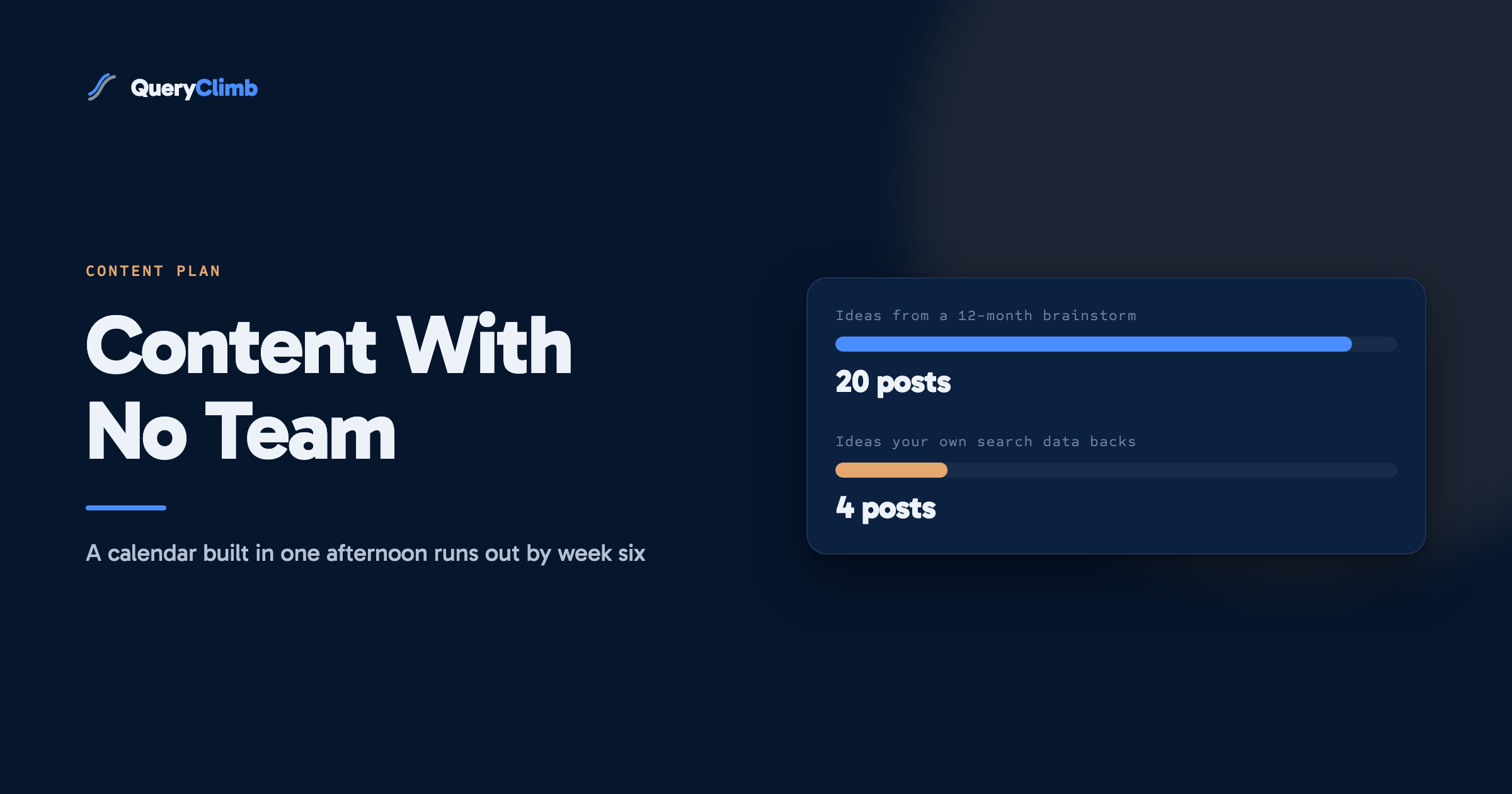
The pattern is always the same. Somebody builds a calendar with twelve months of topic ideas brainstormed in an afternoon. Weeks one to four go fine, because the good ideas were at the top. By week six the ideas left are the weak ones, the store owner is writing “5 Coffee Gift Ideas For Dad” out of duty, and the traffic from it is zero. Two weeks later the calendar is abandoned and the conclusion drawn is that content marketing does not work for small stores.
The plan was the problem. Ideas brainstormed in an afternoon are guesses about demand. Once you exhaust the ones that happened to be right, you are publishing guesses. A process that generates fresh, evidence-backed topics every month never runs out in the same way, because the evidence keeps arriving.
Worth knowing
A twelve-month calendar built in one sitting is a list of guesses sorted by how good they felt on the day. The strong ones are used up in a month. What follows is the weakest ideas you had, published on a deadline.
Where do topics come from when you have no research budget?
From three places you already own, in this order.
Your own Search Console. Queries where you rank at position 5 to 20 with real impressions are the best briefs available to a store, because Google has already decided you are relevant and the remaining work is smaller than starting cold. The full walkthrough of that report covers the filters and the prioritisation. The signal to hunt for on a store is a query with informational intent whose ranking page is a product or collection page. If Google is ranking the roastery’s grinder product page at position 14 for “burr vs blade grinder”, it is asking for an article and settling for the wrong page.
Your inbox and your order notes. Every question a customer emails you is a question others typed into Google and did not bother asking. A roastery gets “how long do beans stay fresh after roasting” perhaps twice a week. That is a post, and it is a post you can write in an hour because you have answered it forty times.
Your on-site search box. Shopify records what people type into your store search. A run of searches for “decaf” against a catalogue with one decaf bean is a merchandising signal and a content signal at once.
What none of these is: a keyword tool’s list of high volume terms in your category. Those lists are how stores end up targeting “best coffee beans” at difficulty 70 against publishers with twenty years of authority, publishing a post that will never rank, and concluding the channel is broken.
How do you decide what not to write?
By checking whether one of your own pages already targets the query, and dropping the idea if it does. This single rule prevents most of the damage stores do to themselves.
Before an idea becomes a post, search site:yourstore.com "the query" and run the same phrase through your store search. If anything plausible comes back, the job is to improve that page rather than write a rival to it. Two of your own pages competing for one query splits the signal and both rank worse. On a store the page that loses is often the collection page that was quietly earning money, which makes the new article a net loss even when the article itself ranks respectably. We keep a longer treatment of the diagnosis and the fix in the cannibalisation guide.
The related discipline is knowing when a refresh beats a new post. A roastery article on espresso grind sitting at position 9 is closer to traffic than a blank document, and updating it is a two-hour job against a two-day one. Content refresh has its own rules about which pages qualify.
What does a four-hour content week look like?
Split it as roughly ninety minutes of deciding and two and a half hours of making, and protect the deciding half.
- Monday, 30 minutes. Pull the striking distance report. Add anything new to a running candidate list with its impressions, current position and current ranking URL.
- Monday, 30 minutes. Run the veto on the top few candidates. Each gets one verdict: write it, refresh an existing page, or leave it alone. Most weeks the honest answer for half the list is leave it alone.
- Tuesday to Thursday. Write one piece. Question-phrased headings that mirror how people actually search, each answered in its first sentence before the detail. A precise 1,200 words beats a padded 2,500.
- Friday, 20 minutes. Wire the links. Point two or three existing pages at the new article, including whichever product or collection page was previously ranking for the query, and link from the article out to the products it should sell. Skipping this is the commonest unforced error in store content. Internal linking on Shopify covers the mechanics.
- Friday, 20 minutes. Check last month’s publishes. Climbing means leave it. Flat after six weeks means the piece missed the intent and needs a second pass.
That is a week you can hold for a year, which matters more than any individual decision inside it.
What the data showed us
Across six months of Search Console data from our own store, 88 percent of clicks came from 147 blog articles rather than from product or collection pages. Monthly clicks moved 224 in March to 5,368 in the first twenty days of August. The articles were not written faster than one or two a week; the number that matters is how many months in a row they were written.
How many posts a month does a store actually need?
Two to four, provided each one came off the evidence list rather than out of a brainstorm.
Volume targets are where content marketing goes wrong for stores. If your data shows six genuine opportunities this month and you have committed to twenty posts, fourteen of them are invented, and invented posts do more than waste time. They compete with your real pages, dilute the crawl budget on a store that already has hundreds of product URLs, and pull down the average quality of a domain that is being judged as a whole.
The counter-argument is that more posts means more chances to get lucky. It is true for a publisher with a staff of writers and no product pages to protect. It is false for a store, where the downside of a bad post lands on the pages that make money.
How do you tell whether it is working?
Track the target query of each published piece, weekly, for six weeks, and judge nothing before then.
Sessions and pageviews are too noisy at store scale to tell you anything in month one. Position on the specific query you aimed at is not. A roastery post targeting “how to store coffee beans” that moves from unranked to position 18 to position 11 over five weeks is working, even though the click count is still near zero, because position 11 is one good refresh away from page one. Waiting for the traffic number to move before believing the content is worth doing means quitting in week five of an eight-week process.
Revenue attribution is the honest weak spot. Someone who read your brewing guide in March and bought in May is recorded as a direct visit or a branded search. Do not build the business case on last-click attribution, because last-click will tell you content does nothing.
What does this cost, and where does software fit?
The method above costs four hours a week and nothing else. That is the honest baseline, and plenty of stores should stop there.
What software changes is which of those hours you spend. Pulling the report, cross-checking every candidate against your existing pages, tracking six weeks of positions per piece, and finding the pages that link to nothing are repetitive data work, and that is the part we automated into QueryClimb: Search Insights for the signal, the Content Calendar for the monthly plan, the Blog Writer for supervised drafting with the cannibalisation veto enforced, and Wise Links for the linking pass. The pricing page has the tiers, and the case study has the numbers from our own store with the caveats attached.
What software does not change: whether your answer to “why does my coffee taste sour” is better than the one already ranking. That is still you.
Key takeaway
Publish from evidence, not from a schedule. Two posts a month that came off your own Search Console beat twenty that came off a brainstorm, and the second approach actively costs you rankings on pages that were already earning.
Frequently asked questions
How long before ecommerce content marketing pays off?
Refreshes of pages that already rank often move within one to three weeks. New articles usually take four to eight weeks to settle, longer on a young domain. The compounding effect, where related articles lift each other and internal links accumulate, is a two-to-four-quarter story. Budget six months before judging the channel.
Should a small store blog or put the effort into social?
Blog, if you can only pick one. A social post has a life of three days and is rented from a platform that can change the rules. An article that ranks keeps working for years and sits on a domain you own. Social is a good distribution layer on top of content that already exists.
Is AI-written content safe for an ecommerce blog?
Quality decides it, not method. Content generated in bulk from a keyword list and published unread is what Google’s spam systems target. Content drafted with AI from your own search data, checked against your existing pages, edited by someone who knows the category, and published under a named author performs like any other good content. The distinction is supervision, not tooling.
What if my store is too new to have Search Console data?
Then start with the questions customers ask you directly and the obvious category basics, and check Search Console monthly until impressions appear. Usually within eight to twelve weeks there is enough data to switch over. Do not buy a keyword tool subscription in the meantime; your inbox is a better brief than a volume estimate.
How do I stop the blog cannibalising my collection pages?
Run the site search check before every new post, and when the intent behind a query is commercial rather than informational, improve the collection page instead of writing an article. A search like “single origin coffee beans” wants a category page. A search like “what does single origin actually mean” wants an article. Getting that split right removes most of the risk.