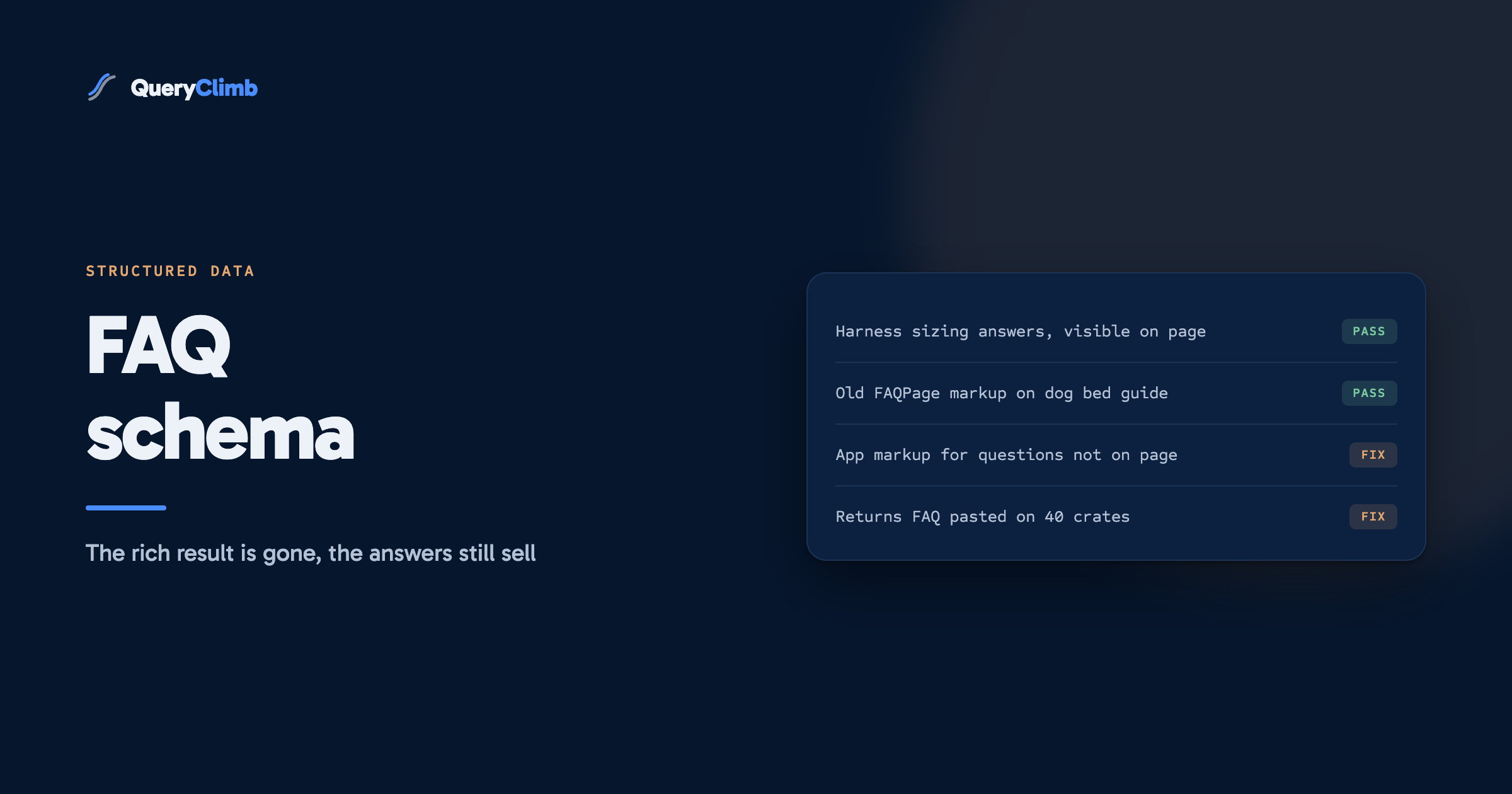
The short answer
FAQ rich results are gone from Google Search for every site: Google restricted them to government and health sites in 2023, then stopped showing them entirely from 7 May 2026. Existing FAQPage markup does no harm and does not need a removal project, but adding new markup earns nothing in Google. The questions and answers themselves are still worth writing as visible text on the page, because shoppers read them and answer engines quote them.
FAQ schema used to be the cheapest trick in ecommerce SEO. Add a block of FAQPage JSON-LD under a product description, and Google would sometimes expand your result into a stack of questions that pushed competitors down the page. For a few years every SEO app sold it.
That trick is finished. Google narrowed it in 2023 and switched it off completely in May 2026. The searches have not caught up, and plenty of stores still pay for apps whose headline feature no longer does anything in Google.
This post covers what happened, with Google’s own changelog as the source, what to do with markup you already have, and why the questions themselves are still worth writing. Examples run through a pet gear store: dog harnesses, orthopaedic beds, leads, travel crates and a cat tree or two.
What is FAQ schema?
FAQ schema is structured data, usually JSON-LD, that labels a block of questions and answers on a page using the schema.org FAQPage type. Each question is a Question with an acceptedAnswer, and the whole set sits inside one FAQPage object.
On a dog harness product page it would say, in machine-readable form, that the page contains the question “How do I measure my dog for a harness?” and this specific answer. The markup does not change what a shopper sees. It describes text already on the page so software can pick the pairs out without guessing.
The schema.org type still exists and still validates. What changed is what Google does with it.
Does Google still show FAQ rich results?
No. Google stopped showing FAQ rich results for all sites from 7 May 2026, and it has since removed the documentation for the feature altogether.
The sequence is recorded in Google’s own Search Central documentation updates page:
- August 2023. Google announced that FAQ rich results would only be shown for well-known, authoritative government and health websites. For everyone else, including every store, the expanded result stopped appearing regularly. How-to rich results were cut back at the same time.
- 8 May 2026. A deprecation notice went on the FAQ documentation, stating that the feature would no longer appear in Google Search from 7 May 2026.
- 15 June 2026. Google removed the FAQ rich result documentation, noting that the feature is no longer shown in search results. The old documentation URL now redirects to that changelog entry.
So for a store, the practical end came in 2023 and the formal end came this year. FAQ markup added to a product page since August 2023 was never going to appear, and a 2026 guide promising FAQ rich results was written without checking.
Worth knowing
The SERP for this query still carries a Reddit thread announcing the removal and a YouTube short insisting FAQ schema is not dead. Both can be half right. The rich result in Google is gone. The markup is still valid schema.org, and other software can read it. What nobody should claim is that it earns a Google feature, because Google’s own changelog says it does not.
Should you remove FAQ schema from your store?
Not as a project. If markup is already on your pages and it describes answers a shopper can see, leave it where it is until you next touch that template.
Google said as much when it restricted the feature in 2023. The announcement noted that you can drop the structured data but there is no need to proactively remove it, because structured data that is not being used does not cause problems for Search and also has no visible effect. Nothing in the 2026 notices reversed that.
There are two cases where removal is worth an hour.
The first is markup that describes text a shopper cannot see. Google’s general structured data guidelines say not to mark up content that is not visible to readers of the page, and list hidden content among the reasons for a structured data manual action. Collapsed accordions are fine, since the reader can open them. The problem is the FAQ app that injects questions appearing nowhere in the page body, or a theme setting that fills the markup from a metafield the template never prints. That was always against the guidelines. Now it carries the risk with no upside.
The second is an app you pay for mainly to generate it. A common pattern is a dedicated FAQ schema app running alongside a general SEO app, each emitting its own block. If the app does nothing beyond the markup, it is a subscription for a feature Google retired.
Does FAQ schema help with AI Overviews or ChatGPT?
Not in any way Google recognises, and no other engine has said it does. Google’s own guide to optimising for generative AI features in Search lists “overfocusing on structured data” among the things you can ignore, and states that structured data is not required for generative AI search and there is no special schema.org markup you need to add.
That is the clearest statement any engine has made on the question: the text on the page is what gets read. An AI Overview answering “how tight should a dog harness be” lifts a sentence that answers the question, from a page that reads as though someone who fits harnesses wrote it. A JSON-LD block does not make a vague paragraph quotable.
OpenAI and Perplexity have not published anything saying they use FAQPage markup to choose citations. Their crawlers may parse it. That is not something to build a plan around, and we would not pay for a tool that promises it.
What the data showed us
The keyword numbers say demand has not noticed the removal. On the morning we wrote this, “faq schema” ran at 880 US searches a month at difficulty 48, and its monthly series peaked at 1,300 in May 2026, the month the feature was switched off. “faq schema generator” still draws 480 a month. People are still being told to add it.
Is it still worth writing FAQs on product pages?
Yes, as visible text, for the shopper and for the answer engines. The markup lost its Google feature. The questions never lost their job.
On a pet gear store the questions that matter are the ones that stop a sale or cause a return:
- How do I measure my dog for a harness, and what if they sit between sizes?
- Is the orthopaedic bed cover machine washable, and at what temperature?
- Will this crate fit on the back seat of a hatchback?
- Can a cat tree this tall go on laminate without tipping?
Each is a real support email, and each answered on the page is a return that did not happen. They are also the phrasing people type into Google and ChatGPT, so an answer engine can lift a clean two-sentence answer about harness fit and cite you for it. The Shopify blog SEO system uses the same principle for articles: question-phrased headings that answer in the first sentence.
A product FAQ earns its place by being specific. “What is your returns policy?” pasted onto forty product pages adds nothing to any of them; it belongs on one returns page. Keep the questions that only make sense for that product.
Key takeaway
Write the FAQ for the shopper who is about to email you, keep it visible, and stop there. The markup is optional housekeeping. The answers are the part that sells and the part that gets quoted.
Where do good FAQ questions come from?
From three places, in order of how much we trust them: your support inbox, your Search Console queries, and the People Also Ask boxes in Google.
The support inbox is the best source because every email is a question someone cared enough to ask. If people keep asking whether the travel crate folds flat, that question belongs on the crate page.
Search Console’s Performance report shows the actual queries a page appears for, and question-shaped queries with impressions but few clicks are the questions Google already associates with you. The same method finds striking distance keywords: read the queries a page already earns and write to them. QueryClimb’s Search Insights does this per page, but the free filter in Search Console gets you the same list with an afternoon of exporting.
People Also Ask is useful for phrasing and weak for priority, because a PAA question has no search volume attached.
Where a question needs more than a paragraph, it has outgrown the FAQ. “How do I choose a harness for a dog that pulls?” is a buying guide, and a buying guide can target its own query and link down to the products. That is how a store builds a content calendar from questions rather than from guesswork.
How do you check what FAQ markup your store is emitting?
View source on a product page and your FAQ page, and search for FAQPage. That tells you in two minutes whether a theme or app is emitting it.
For a cleaner read, paste the URL into the Schema Markup Validator at validator.schema.org, which reports every structured data type on the page. You are looking for three things:
- More than one
FAQPageblock on the same page, which usually means two apps are both emitting it. - Questions in the markup that you cannot find in the visible page text.
- The same generic questions repeated on every product.
When we checked our own store, Supplements Wise, this morning, its FAQ page at /pages/faq carried no FAQPage markup at all. It does not need any. What counts in 2026 is whether the answers are visible.
Shopify’s own Dawn theme contains no FAQPage markup, collapsible content sections included. When it appears on a store, it usually came from an FAQ or accordion app, or a snippet pasted into the product template. Our post on what Shopify schema markup the theme already emits walks through the rest of the audit, and product page SEO on Shopify covers what outranks the markup work by a distance.
What about QAPage markup instead?
It is not a substitute, and using it on an FAQ is a guideline breach. Google’s QAPage documentation is explicit that the markup is for pages focused on a single question where users can submit answers, such as a forum thread. It lists an FAQ page written by the site itself, and a product page with multiple questions, as invalid use cases.
A community forum where owners answer each other’s crate training questions could use it on those threads. A product page with five questions you wrote cannot. Swapping FAQPage for QAPage is a workaround we expect some apps to sell, and it breaks the rules in a way FAQPage never did.
What should a store do this week?
Very little. The markup question takes an hour; the questions take longer.
- Check one product page for FAQPage markup. If it is there and matches visible text, leave it.
- If an app emits markup for questions that are not on the page, remove the markup or print the questions.
- If you pay for an app only for FAQ schema, cancel it.
- Pull ten real questions from the support inbox and Search Console, and answer them as visible text on the pages they belong to.
- Turn any question that needs more than a paragraph into a guide.
Step four is where the value is, and it needs no tool. If you would rather the question-mining and first drafts happened without the spreadsheet, that is what QueryClimb’s Blog Writer is for, with plans on the pricing page. The manual method works. The tool buys back the hours.
Frequently asked questions
Is FAQ schema dead?
The Google feature is. FAQ rich results stopped appearing in Google Search for all sites from 7 May 2026, and Google removed the documentation in June 2026. The FAQPage type itself is still valid schema.org, and existing markup causes no problems, but it no longer earns anything in Google’s results.
Does FAQ schema still help SEO?
Not directly. It never affected rankings, and the rich result it enabled is gone. The visible questions and answers still help, because they answer real queries and give answer engines a clean sentence to quote.
Should I remove FAQPage markup from my Shopify store?
Only if it describes questions that are not visible on the page, or if you are paying for an app just to generate it. Google said in 2023 that there is no need to proactively remove unused structured data, and markup that matches visible text can stay until you next edit the template.
Does FAQ schema help you appear in AI Overviews?
Google says no special markup is needed for its generative AI features and lists overfocusing on structured data as something to ignore. What gets quoted is the text on the page, so write the answer clearly in the page body.
Can I use QAPage schema instead of FAQ schema?
Not on an FAQ you wrote yourself. Google’s QAPage guidelines limit it to single-question pages where users submit answers, such as forum threads, and name site-written FAQ pages as an invalid use.