The short answer
People Also Ask shows the questions Google links to a search, so it is the fastest way to find how buyers phrase things and which sub-questions a buying guide has to answer. It carries no search volume, so use it to shape headings and FAQs, and use Search Console or a keyword tool to decide which page is worth writing at all.
Search a question in Google and, a little way down the page, there is a box of other questions. Click one and it opens into a short answer from someone’s site, with more questions appearing underneath. That box is People Also Ask, and for a store planning content it is the most useful free research tool there is, provided you ask it the right thing.
It is very good at telling you how people phrase a problem and which follow-up questions sit next to it. It is bad at telling you whether any of those questions is worth a page. Most PAA advice skips that second half, and it is where stores waste their writing time.
Examples run through a cookware store: cast iron skillets, enamelled Dutch ovens, carbon steel pans, chain mail scrubbers and a seasoning oil.
What is People Also Ask in Google?
People Also Ask is a panel of related questions that Google shows on many search results pages, each of which expands into a short answer taken from a web page with a link to the source. Google’s own name for it is a “related questions group”, and its visual elements gallery describes it as a cluster of questions related to the original search.
The questions are Google’s, not the searcher’s, and the set shifts between days and devices. The answers are pulled from ordinary pages, with no special format to submit. Google’s featured snippets documentation notes that featured snippets can appear inside related questions groups, and the same rule applies to both: Google’s systems decide which page makes a good answer, and there is no markup that makes you eligible.
And the box grows as you use it: every question you expand adds more below it, so one search can unfold into dozens. That is the feature a store should exploit.
How does Google choose which answers go in the box?
Google picks a passage from a page that it judges answers the question well, and there is nothing you can add to a page to force that choice. The featured snippets page says so directly: you cannot mark a page up to become a snippet. What you control is whether your page states a clear answer to the question in plain words, near a heading that asks it.
You can opt out. The same documentation describes the nosnippet rule and the data-nosnippet attribute, which stop Google using a page’s text in snippets, and a low max-snippet value, which makes a featured snippet less likely without guaranteeing it. Few stores would want to, but it is worth knowing the switch exists.
Worth knowing
FAQ markup does not get you into People Also Ask. Google retired the FAQ rich result in 2026, and even before that the markup controlled a different feature. The visible question and answer on the page is what Google reads for the box. The history is in the post on FAQ schema.
Why is a People Also Ask question not a keyword?
Because it comes with no search volume, and many of the questions in the box are ones almost nobody types. Google shows a question because it relates to the search, not because it is popular in its own right. A keyword tool will often report ten searches a month or none for a perfectly sensible PAA question.
This is the trap. A store owner searches “cast iron skillet”, expands the box a few times, and comes away with forty questions that all look like blog posts: dishwasher, soap, stickiness, non-stick. Forty questions become forty planned posts, and most never earn a click, because each is a sentence-long answer Google shows in the box itself.
A PAA question tells you three useful things instead:
- The words buyers use. “Sticky” is a buyer’s word. “Polymerised oil residue” is not.
- The sub-questions that surround a topic, which is the outline of a good guide.
- Which questions Google is already happy to answer in a paragraph, which is a hint that they belong inside a bigger page rather than on one of their own.
What it does not tell you is demand. For that you need Search Console, which shows the queries your own pages already appear for, or a keyword tool that reports monthly searches. The method for reading Search Console that way is in the guide to striking distance keywords.
How do you mine People Also Ask to plan a buying guide?
Start from a query with real demand, expand the box until it starts repeating itself, and sort what you collect into headings, FAQs and a short list of possible separate pages. The whole job takes about half an hour per guide.
Here is the routine we use, with a cookware store as the example.
- Pick the seed. Choose the query the guide will target, confirmed with volume from Search Console or a keyword tool. For a cookware store, something like “how to season a cast iron skillet” or “best cast iron skillet”.
- Search in a private window. A logged-out browser gives a less personalised page.
- Expand every question once. Keep going until the new ones are mostly rewordings of old ones, usually after twenty to thirty for a focused buying topic.
- Copy the questions into a sheet, not the answers. You want the phrasing and the spread. Copying answers leads to writing a paraphrase of someone else’s page.
- Note which site answered each one. If forums and manufacturer pages answer most of them, a store with real product experience has room.
- Group by intent. Questions about seasoning, cleaning, cooking, choosing and comparing tend to fall into clear clusters.
The result is something a keyword tool does not give you: a map of what a buyer worries about, in their words, around one purchase.
Which questions become H2s, which become FAQs, and which need their own page?
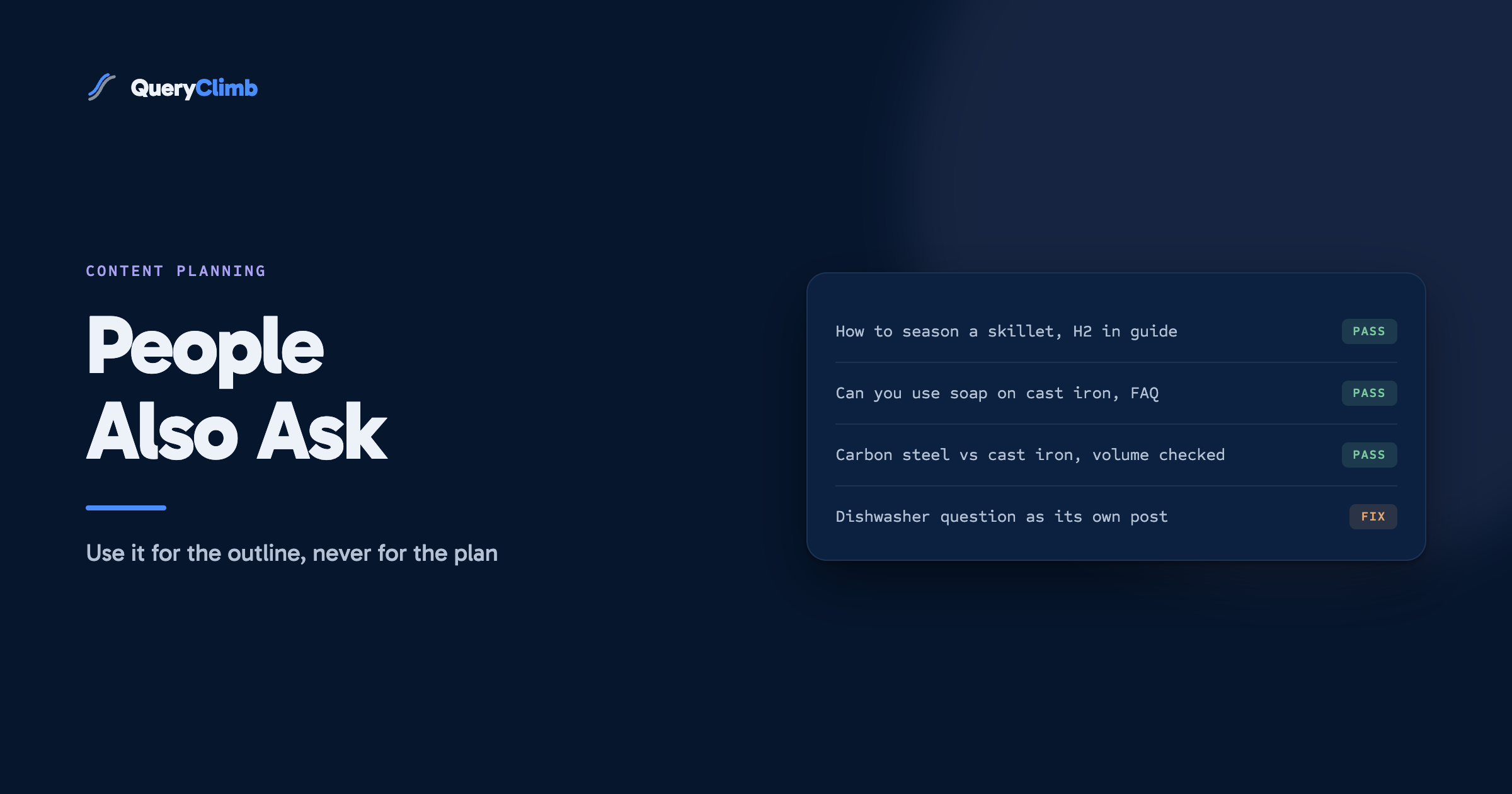
Use the size of the answer to decide. A question that needs several paragraphs and shapes the buying decision is an H2 in the guide. A question with a one or two sentence answer goes in the FAQ at the bottom. A question that is really a separate purchase, with its own volume, gets its own page.
Taking the cast iron example, a sorted list might look like this:
- “How do you season a new cast iron skillet?” This is the core of the guide and becomes an H2 with the method.
- “Why is my cast iron sticky after seasoning?” This is the failure people hit on their first attempt, and it deserves an H2 because the fix explains the method.
- “Can you use soap on cast iron?” One paragraph. FAQ.
- “Can you put cast iron in the dishwasher?” One sentence. FAQ.
- “Is carbon steel better than cast iron?” A comparison with its own buyers. If the volume holds, it is a separate page the guide links to.
- “What oil is best for seasoning cast iron?” An H2 or a separate page, depending on its own demand. If you sell a seasoning oil, it is the page closest to a sale.
Six thin posts from six seasoning questions would compete with each other and with the guide, the failure covered in keyword cannibalisation on Shopify. One guide for the whole cluster is easier to rank and to maintain.
This is also how we build a content calendar: one guide per demand-backed topic, with PAA supplying the outline, rather than one post per question.
How do you write an answer Google can use in the box?
Put the question in a heading, answer it in the first sentence underneath, then explain. That is the whole technique, and it is the same structure every post on this site uses.
A first sentence that works as an answer on its own is the part that matters. “Yes, a little mild washing-up liquid will not strip seasoning that has been built up properly” answers the soap question. “Many people wonder whether soap is safe for cast iron, and the answer might surprise you” does not, and Google has nothing to lift from it.
From our own writing rather than any documented rule: use the buyer’s phrasing from the box in the heading, keep the direct answer to a sentence or two before the detail, and answer from experience. A cookware store knows which pans come back as returns and why, and that is what a generic answer lacks. None of this guarantees a place in the box. It makes your page a reasonable candidate.
What the data showed us
”people also ask” gets about 2,900 US searches a month at a difficulty of 42, steady across the past year, from the research we ran on 28 September 2026. The questions about ranking in the box are far smaller: “how to optimize for people also ask” is about 70 a month and “how to rank in people also ask” about 50. Most people searching the term want a tool to read the box, not a way into it, and that matches how we think a store should use it.
Can you see People Also Ask traffic in Search Console?
Only partly, and it is easy to undercount. Google’s help page on impressions, position and clicks sets out the rule for expandable question results: an impression is counted for a link in the box only when someone expands the question, and a click is counted only when someone clicks a link to your site inside it. Opening the question is not a click.
So if your skillet guide answers a question nobody expands, Search Console records nothing. If people expand it, read the answer and move on, you see an impression and no click, one reason a page can sit at a good position with a poor click-through rate.
We have not found a clean way to isolate PAA appearances in the Performance report. The workable check is manual: search your targeted questions monthly in a private window and note whether your page is the source. The queries per page still show whether the guide is gaining visibility for the question-shaped searches around it, which is what matters.
Is a People Also Ask tool worth paying for?
For most stores, no. For one guide at a time, expanding the box by hand gives you what a tool would. Tools such as AlsoAsked earn their keep when you research dozens of topics or several countries and want the question tree exported. An agency needs that; a store writing a few guides a month usually does not. And no tool fixes the missing volume.
Key takeaway
Use People Also Ask for the outline, not the plan. Demand decides which guides to write. The box decides what each guide has to cover and how to phrase it. Short answers go in the FAQ, long answers become H2s, and only questions with their own search volume get their own page.
Where does this fit in a store’s content routine?
At the outline stage. Our order: find the topic in Search Console data, confirm demand, mine PAA for the structure, write, then link the guide to its products. The wider system is in Shopify blog SEO.
All of it can be done by hand with Search Console, a private browser window and a spreadsheet. QueryClimb does the first two steps from your own Search Console data in Search Insights, drafts the guide with Blog Writer, and suggests the product links through internal linking. It buys back the hours rather than doing something the manual method cannot. The pricing page lists what it costs, and the case study shows how we used the same routine on Supplements Wise.
Frequently asked questions
How do I get my store into People Also Ask?
You cannot apply or mark up a page to get in. Put the question in a heading on a relevant page, answer it plainly in the first sentence below, and make the rest of the page useful. Google’s systems choose the source, so the best you can do is make your page a clear candidate.
Does People Also Ask show search volume?
No. The box shows questions Google relates to your search, with no numbers attached. Many PAA questions have little or no search volume on their own. Check demand in Search Console or a keyword tool before turning a question into a page.
Is People Also Ask the same as a featured snippet?
They are related but different. A featured snippet is a single highlighted answer near the top of the results. People Also Ask is a group of related questions, each of which expands into an answer. Google’s featured snippets documentation notes that featured snippets can appear inside the related questions group.
Why do People Also Ask questions keep changing?
Google chooses the questions and updates them as it sees fit, and the set can vary by device, location and day. That is why it is worth recording the questions in a sheet when you research a guide rather than relying on seeing the same box again later.