The short answer
For one store, SE Ranking's entry plan is the better buy if the main job is tracking your own rankings: it was cheaper on the day we checked and tracks four times as many keywords daily. Semrush earns its higher price only if you regularly research competitors' sites. For most stores the honest answer is that Search Console does the weekly job free, and either paid tool is worth a single month when you need competitor research.
Most SE Ranking vs Semrush comparisons are written for agencies. They weigh client reporting, white-label dashboards and how many projects each plan holds. A store owner has one site, no clients and a narrower question: which of these is worth paying for, if either is.
So this comparison is sorted by the jobs a single store opens an SEO tool to do, and every price and limit comes from the vendors’ own pricing pages as they appeared to us on 1 October 2026. The examples come from a store selling suede boots, leather shoes and footwear care kit: brushes, protector sprays and cleaning blocks.
Is SE Ranking or Semrush better for a small online store?
SE Ranking is the better fit for most small stores, because its entry plan costs less and tracks more of your own keywords, and tracking your own keywords is the job a store does most often. Semrush is the better tool when the job is researching competitors’ sites, and that is a job most stores do a few times a year, not every week.
That is the short version. The rest of this post shows the working, because “better” depends entirely on which job you are paying for. If you have read our guide to Semrush alternatives, this is the head-to-head that guide points towards: same principle, narrowed to the two tools people most often shortlist.
How much do SE Ranking and Semrush cost?
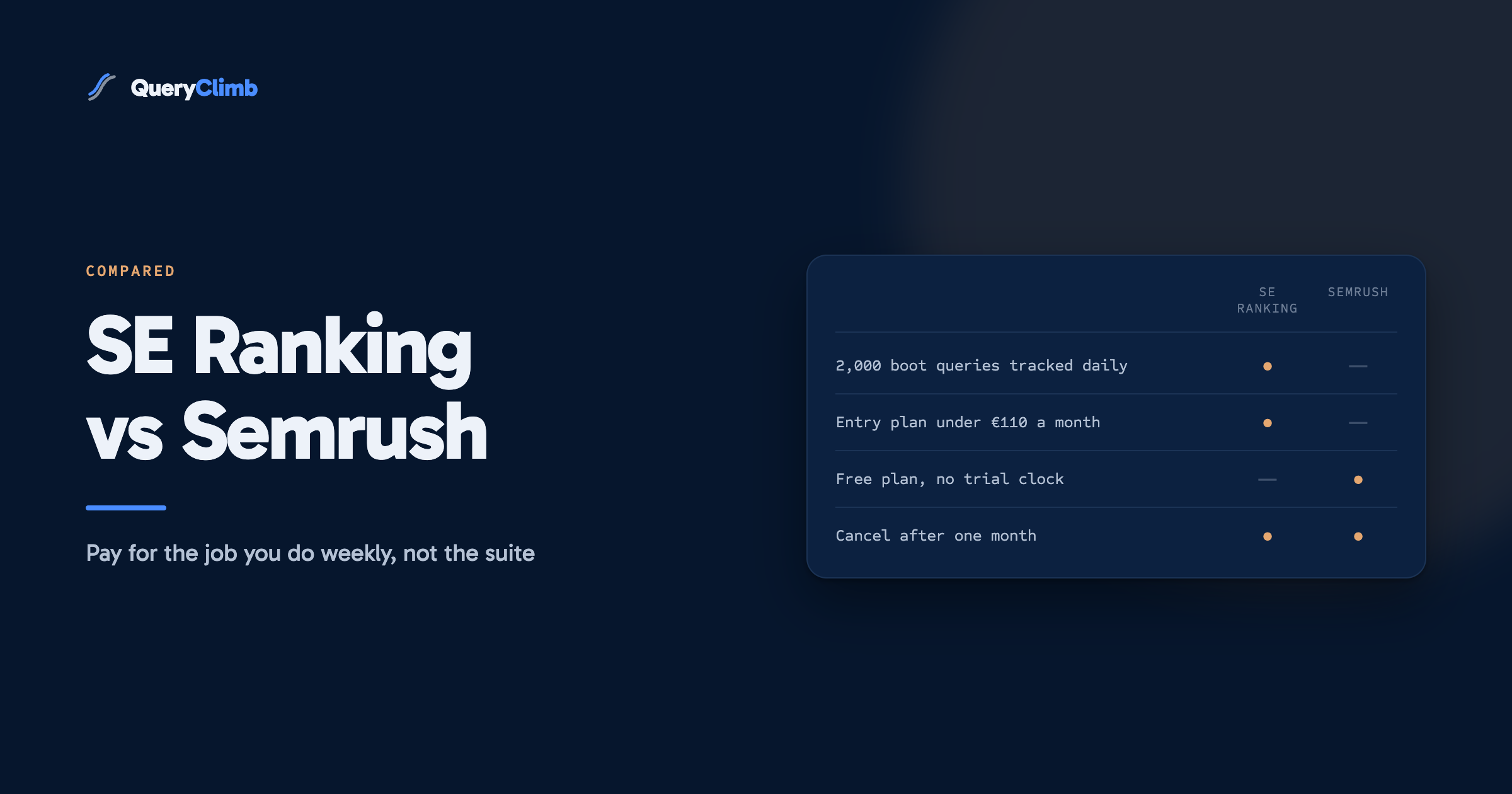
On 1 October 2026, SE Ranking’s entry Core plan was €109 a month on monthly billing, and Semrush’s entry SEO plan was €134 a month. Both pages showed euros to us; yours may show pounds or dollars, and the numbers move often, so read both pages on the day you decide.
Here is what each entry plan listed:
| SE Ranking Core | Semrush SEO | |
|---|---|---|
| Monthly billing | €109 a month | €134 a month |
| Annual billing | €87.20 a month | €112.52 a month |
| Keywords tracked daily | 2,000 | 500 |
| Projects or websites | 10 projects | 5 websites |
| Users included | 1 manager seat | 1, extra users from €43 a month |
| Free trial | 14 days, no card | 7 days |
| Free plan | None | 10 reports a day, 1 demo project |
Sources: SE Ranking’s subscription page and Semrush’s pricing page.
Two things stand out. The first is that SE Ranking tracks four times as many keywords on its entry plan for less money. The second is that Semrush keeps some features a store might want for higher tiers: its pricing page lists historical SEO data and keyword cannibalisation analysis under Pro+, at €286 a month on monthly billing, not on the entry plan.
Extra seats follow the same pattern. SE Ranking listed extra manager seats from €14.40 a month; Semrush listed additional users from €43. If two people in the business need logins, that gap matters more than the headline price.
Worth knowing
SE Ranking publishes its own “SE Ranking vs Semrush” page, and it ranks on the first page for the query. Read it as a sales page, because that is what it is. The same goes for Semrush’s material on its competitors. Every figure in this post comes from the plain pricing tables, not from either vendor’s comparison copy.
Which is better for tracking your own rankings?
SE Ranking is better for tracking your own rankings at entry level, because 2,000 daily-tracked keywords is enough to cover a whole store’s product, collection and guide queries, while 500 forces you to choose.
Think about what a footwear care store would want to watch. Each boot style has its own product queries (“suede chelsea boots”, “suede desert boots”). Each care product has buying queries (“suede protector spray”, “suede brush”) and how-to queries (“how to clean suede boots”, “how to get water stains out of suede”, “can you wear suede in the rain”). Add colour and material modifiers and a store with forty products passes 500 tracked phrases without trying.
But before paying either vendor for this job, ask whether you need a daily rank tracker at all. Google Search Console already reports every query your pages earned impressions for, with clicks and average position, from Google’s own data. Google’s Search Console getting started guide describes the Performance report as the place to see which queries bring people to your site.
A paid tracker adds three things Search Console lacks: a check every day for a fixed list, positions for queries where you earn no impressions yet, and a tidy history beyond Search Console’s sixteen months. Those are real, but for a store they are conveniences. Search Console’s average position is also more honest than it looks once you know how it is calculated, which our average position guide explains.
What the data showed us
The searches behind this post are themselves a small lesson in reading tool data. In the US, “se ranking vs semrush” averaged 390 searches a month at a difficulty of 26 in the keyword data we pulled on 1 October 2026. The monthly series ran between 70 and 390 for most of the past year, with a single month at 2,400 in September 2025. A headline average that includes one spike month overstates steady demand. Read the series before you trust the average, in either tool.
Which is better for keyword research?
Both will do keyword research well enough for one store; Semrush’s case rests on its competitor data, covered below, more than on keyword ideas for your own site. For a store, though, the order you research in matters more than which database you pay for.
Start with your own Search Console query list. A footwear store will find queries its pages already appear for at positions 8 to 20: perhaps the suede brush product page showing for “how to restore suede shoes”. That is a brief Google has already half-approved, and our striking distance guide covers how to filter for them. No paid database tells you that, because no paid database sees your impressions.
Only after that list is worked through does a paid keyword database earn its place, for finding topics you have no impressions for yet. Either tool will hand you volume estimates for “suede protector spray” and its variants. Neither estimate will match Search Console exactly, and neither needs to. You are comparing phrases with each other, not predicting traffic.
Our own approach at Supplements Wise has been the same: the content plan starts from Search Console and the paid tools fill gaps. The case study shows what that produced on a real store.
Which is better for competitor research?
Semrush is the tool to use when the job is seeing what a competitor ranks for, and it is the one job in this list that a free tool cannot do. Search Console, Bing Webmaster Tools and Ahrefs Webmaster Tools all stop at sites you own and verify.
For a footwear care store, competitor research might mean looking at a larger rival’s blog to see which care guides earn it traffic, or checking which boot styles a competing brand ranks for that you sell too. Both tools offer domain overviews and keyword gap reports for this.
The honest point is frequency. A store does this kind of research when planning a new range, writing a content plan for the next quarter, or working out why a rival overtook you. That is a few months a year. Both vendors offer monthly billing and cancellation, so the sensible pattern is a single month of Semrush when the research is due, notes written down, then cancel. Paying all year for a job you do in March and September is the most common waste we see in small store tool budgets.
Key takeaway
Price the job, not the tool. If the job is weekly tracking of your own rankings, Search Console does it free and SE Ranking does it daily for less. If the job is competitor research a few times a year, buy one month of Semrush when you need it. Neither job justifies a year-round agency plan for one store.
Which is better for site audits?
Both run a perfectly adequate site audit for a store, and the audit should not be the reason you choose either. SE Ranking listed 250,000 audited pages a month on Core, far more than a store with a few hundred URLs will use. Semrush includes Site Audit on its entry plan too.
A store’s audit findings are mostly the same short list every time: broken internal links after a product is deleted, redirect chains after a handle change, missing or duplicated titles and descriptions, images without alt text. A free crawler finds all of those, and Search Console’s Page Indexing report tells you what Google actually did with each URL, which no third-party audit can see. On a Shopify store, much of what audit tools flag as an error is platform behaviour that needs no fixing; our post on which Shopify SEO issues are real sorts the two.
What about AI search tracking?
Both vendors now sell tracking of how a brand appears in AI answers, and both price it as a growth area. SE Ranking’s Core plan listed 100 tracked prompts daily, with an AI Search add-on from €79 a month on monthly billing. Semrush’s entry plan lists AI visibility reports, and its next tier, Starter at €190 a month, adds 50 tracked prompts daily.
For a single store this is the feature to be most sceptical about paying for. Prompt tracking tells you whether “best suede protector spray” produces an answer that names you, on the prompts you chose to track. It does not tell you what customers actually typed. The work that earns citations is the same work that earns rankings: answer the question plainly on a page that deserves to be quoted. Our guide to getting a store cited by ChatGPT and Google’s AI covers that work, and none of it needs a tracker.
When do you need neither?
You need neither when your store’s SEO work is mostly writing and improving your own pages, which for a small store it nearly always is. The weekly loop of a store with no SEO team looks like this: check which queries are rising or slipping in Search Console, refresh the pages that are close, write the next guide your customers are asking about, link it to the products it should sell. None of that requires a third-party index.
That is the ground QueryClimb is built on. It reads your Search Console data, finds the near-miss queries and the pages slipping, plans the content calendar and drafts the posts with links to your own products. You can do every step of that by hand with Search Console and a spreadsheet, and we did for a long time; what the tool buys back is the hours. The features overview shows what it reads, and the pricing page shows what it costs next to the two tools above. It is not a competitor research tool and does not pretend to be, so for the one job above where Semrush earns its fee, it does not replace it.
If you are weighing all three, the useful question is which job takes most of your week. For most store owners it is the content: what to write, what to fix, and how to link it. Our Shopify blog SEO guide is the long version of that workflow.
Frequently asked questions
Is SE Ranking cheaper than Semrush?
Yes, at entry level. On 1 October 2026, SE Ranking’s Core plan was €109 a month on monthly billing against €134 for Semrush’s SEO plan, and SE Ranking tracked 2,000 keywords daily against Semrush’s 500. Both prices vary by region and change often, so check both pricing pages on the day you buy.
Is SE Ranking as accurate as Semrush?
We have not tested the two side by side, and neither vendor publishes an accuracy figure we could cite. For your own site, neither is as accurate as Google Search Console, because both check sampled results from outside while Search Console reports Google’s own data. Use the paid tools to compare keywords with each other, not to predict traffic.
Does SE Ranking have a free plan?
No. SE Ranking offers a 14-day free trial with no card required, but its pricing page listed no free plan. Semrush has a free plan limited to 10 reports a day and one demo project, which is enough to look up a few phrases but not to run a store’s research.
Can I use Semrush for one month and cancel?
Yes. Semrush’s pricing page says you can cancel, downgrade or upgrade at any time unless you are on custom terms. For a single store, a one-month subscription when competitor research is due is often better value than an annual plan used a few times a year.
Do I need SE Ranking or Semrush if I have Google Search Console?
Usually not every month. Search Console covers tracking your own rankings and finding the queries you nearly rank for, from Google’s own data, free. A paid tool adds competitor research and daily tracking of a fixed keyword list, which are worth paying for in the months you need them.