The short answer
Give each collection page one commercial query it owns, then write a short lead above the product grid and the longer answer below it. Only do this for collections that map to something a stranger would actually type into Google, and check your own blog is not already ranking for the same query first.
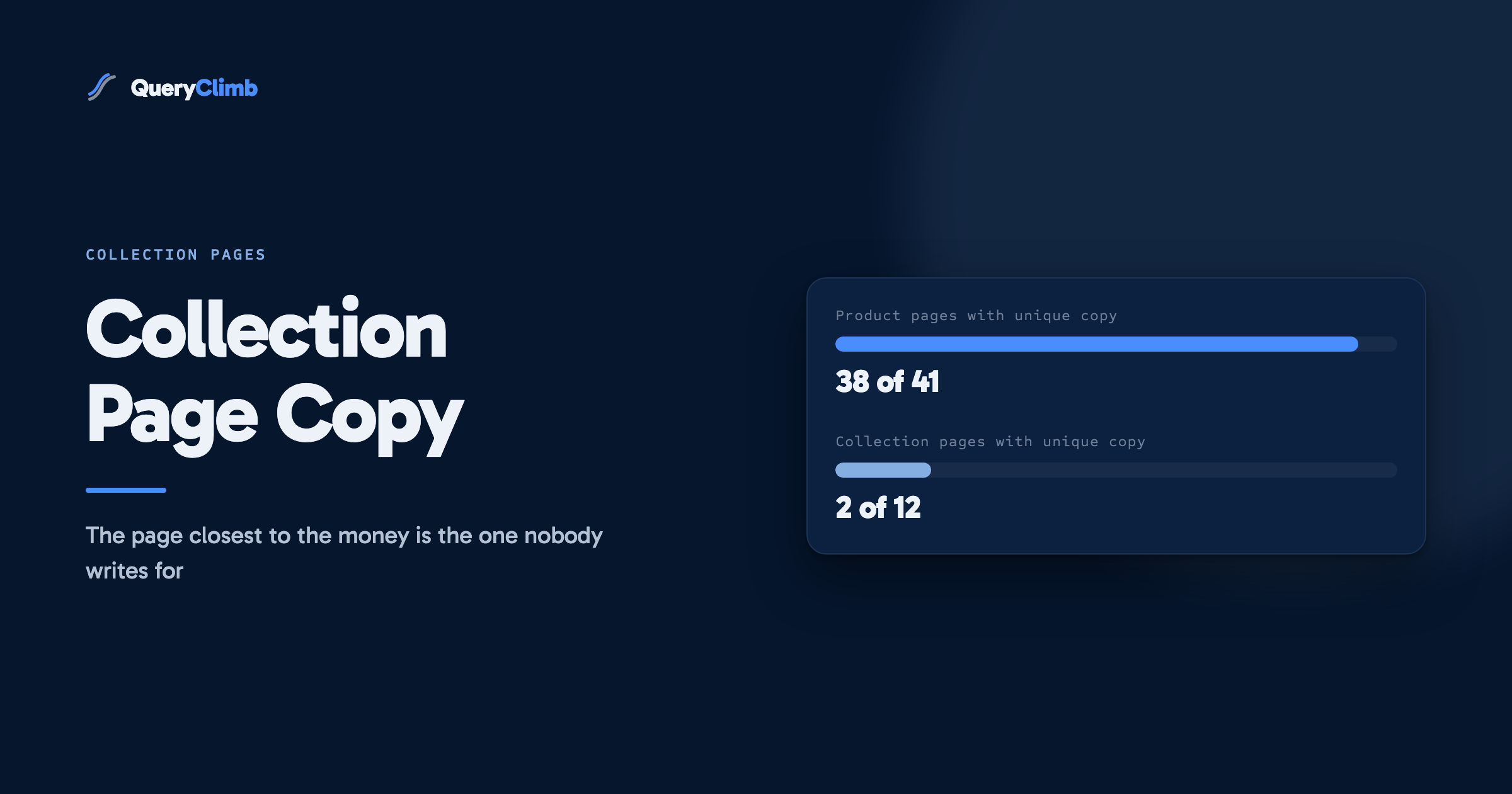
Your collection pages sit one click from checkout, and on most Shopify stores they contain no words at all. That is the whole problem, and it is not a technical one.
A collection page is the closest thing an independent store has to a category page at a big retailer, and it is the page Google is most willing to rank for a commercial query. “No pull dog harness” is a shopping query. Google wants to return a page with a set of no-pull harnesses on it. Your collection page is exactly that page. It loses to a marketplace listing anyway, because the marketplace wrote three hundred words about choosing a harness and you wrote nothing.
This guide covers what belongs on a collection page, where it goes, how long it should be, and which collections deserve none of the effort. The worked examples come from a dog gear store, because harnesses and beds have the sizing and fit decisions that make the argument concrete. We run this routine on our own store, Supplements Wise, as one part of the weekly content loop.
Why do Shopify collection pages rank so badly by default?
Because a default collection page gives Google almost nothing to read. Strip out the theme furniture and what remains is a heading, a filter bar and forty product tiles whose titles also appear on forty product pages and in three other collections. Two collections in the same store can look nearly identical to a crawler, and neither of them says what the category is or who it is for.
The second reason is that stores create collections for merchandising rather than for search. New In, Staff Picks and Bank Holiday Sale are navigation. Nobody types them. A store with thirty collections often has six that match something a person would search for, and those six usually had the description box left empty.
Shopify itself is not the obstacle. The description field exists and every theme renders it. We went through which Shopify SEO complaints are real in a separate triage post, and the empty collection page came out near the top of the list that costs money.
What should a collection page description actually contain?
It should answer the question the shopper is asking at the moment they land: which of these do I need, and how do I choose between them. That is a different job from the product page, which answers “is this specific one right for me”, and different again from a guide article, which answers “how does this category work”.
For a dog harness collection, the person arriving from “no pull dog harness” wants to know four things before they can pick a tile: what front-clip and back-clip actually change about a pulling dog, how to measure a deep-chested breed so the sizing chart means something, whether a harness suits a dog that also wears a coat, and which of these you would not buy for a puppy. Answer those and the grid below becomes usable. Skip them and the shopper goes back to the results page to find someone who did.
What that means in practice, for a collection worth the effort:
- Say what the category is in one sentence, using the words a customer uses rather than your internal taxonomy.
- Give the two or three criteria that decide the choice. Fit and adjustment for harnesses, orthopaedic foam density and washability for beds. This is the part competitors leave out.
- Be specific about sizing, fit or compatibility. A measuring instruction with real numbers is worth more than a paragraph of adjectives.
- Say what you would not recommend, and why. Nothing separates a real store from a dropshipper faster.
- Link down to the sub-collections and across to the relevant guide, so the page routes people rather than trapping them.
Compare that with what most stores have: “Shop our range of premium dog harnesses. We stock the best brands at great prices, with fast delivery and excellent customer service.” That would apply unchanged to a bed, a lead or a raincoat. If a sentence survives being pasted onto a different collection, it was never worth writing.
Worth knowing
Shopify generates URLs for tag-filtered views of a collection, so /collections/dog-harnesses/red and /collections/dog-harnesses/small can end up indexed alongside the parent. They carry the parent’s description word for word with a smaller set of products. Check Search Console for filtered paths picking up impressions, and canonicalise them to the parent unless the filtered view genuinely targets its own query.
Where should the text go, above the products or below them?
Split it, and put most of it below. A short lead of forty to seventy words sits above the grid, gives the category and the one criterion that matters most, then gets out of the way. The longer part goes underneath the products, where it can run to a few hundred words without pushing the first row of harnesses off a phone screen.
This is a commercial decision before it is an SEO one. Someone who searched for a no-pull harness came to look at harnesses. A four-hundred-word essay between them and the first tile costs sales, and the bounce back to Google that follows does not help the ranking either. Google reads text below the fold perfectly well, so there is no ranking reason to put the bulk of it on top.
Collapsing the long section into an accordion is a fine middle path. Google indexes content inside collapsed elements, and the shopper who wants the sizing detail can open it. What does not work is hiding the text in a div nobody can open, which is an old trick that reads as manipulation.
How long should a collection description be?
Long enough to answer the question, which in practice means about 150 to 400 words for a collection you intend to rank, and zero words for one you do not. Word counts imported from a content brief are the wrong instrument here. A harness collection needs the fit and measuring detail. A dog lead collection may be finished in 120 words, because there is genuinely less to decide.
The only useful reference point is what the current page-one results cover. If four of them explain chest measurement and you do not, that gap is the brief. If three pad to 900 words with a history of dog collars, do not copy that.
Padding to hit a number is where stores go wrong. It produces the paragraph about how we have always believed dogs deserve the very best, which neither ranks nor sells.
How do you decide which query a collection page owns?
From your own Search Console, not from a keyword tool. Open the Performance report, filter Pages to contain /collections/, and look at the queries each one already picks up. If /collections/dog-harnesses is sitting at position 14 for “no pull dog harness” with 900 impressions and eleven clicks, Google has already told you which query that page owns. The work is to earn the positions, not to choose the target. Our walkthrough of the striking distance workflow covers the filters in detail.
Then write the mapping down, one collection to one primary query. This sounds like bureaucracy until someone creates a second collection called Anti Pull Harnesses and both pages start splitting the term. The mapping makes that visible in a minute instead of a quarter.
What the data showed us
On our own store, the collection pages that moved after getting real copy were the ones already picking up impressions for a commercial query. Collections that had never had impressions stayed flat no matter how good the writing was, because the demand was not there to begin with. Existing impressions turned out to be the best predictor of whether the work would pay.
Which collections are not worth writing for?
Most of them, and accepting that is what makes the routine finishable. The test is simple: would a stranger who has never heard of your store type this phrase into Google? Dog beds for large dogs passes. Bank Holiday Weekend Picks does not.
The categories to leave alone are merchandising collections that exist to fill a homepage row, seasonal collections that will be empty in six weeks, sale and clearance collections, and automatic tag-filtered views. None of them will rank, and writing copy for them takes time from the six collections that would.
A second group needs a decision rather than a skip: collections that could rank but overlap each other. If you have both Dog Harnesses and No Pull Harnesses, pick the parent, point the other at a narrower query, and link between them. Two pages aiming at one phrase is the cannibalisation problem at its most expensive, because the page that loses on a store is often the one taking the money.
How do you stop your own blog from taking the collection page’s query?
Check before you publish, every time. The guide article “how to fit a dog harness” is informational and should never compete with the collection. The article “best no pull dog harness” is commercial, aims at the same intent as the collection, and one of them will lose.
When the article is the one ranking for a commercial query, try three fixes in order. Re-angle the article towards the informational half of the topic and link down to the collection. Fold the article’s useful content into the collection page. Or, if the article really is the better page for that query, keep it and link to the collection prominently, because a ranking article that routes buyers to the grid is not a loss.
Whichever you choose, wire the links properly. The collection page should be linked from every article in its cluster, with anchor text that names the category, and the collection should link back up to the guide. We covered the full internal linking approach for stores separately, and collection pages are the part of it stores skip most often.
What does this look like as a routine?
List your collections, sort them by revenue over the last twelve months, and work down from the top. For each one: check Search Console for the query it already picks up, write the short lead and the longer section, add the sizing specifics, link to the two most relevant articles, and move on. Thirty to forty-five minutes each once you have found the rhythm.
Ten collections is a fortnight of evenings, and close to a one-time cost. Collection copy does not decay the way an article does. Revisit it when the product mix changes.
None of this needs software. It needs a Search Console export, a text editor and the discipline to stop at the collections that matter. What we built QueryClimb to do is the sorting and the checking: Search Insights surfaces which collection pages are picking up commercial queries at position 5 to 20, the content calendar keeps the collection work in the same queue as the articles rather than losing it, Wise Links finds the articles that should be linking to a collection and are not, and the Blog Writer refuses to draft an article that would compete with a page you already rank with. The pricing page has the tiers, and our own store’s numbers show what the whole loop did over six months. The manual version works. The tool buys back the hours.
Key takeaway
Write collection copy only for collections that already pick up impressions for a query a stranger would type. Existing impressions are the signal that the demand exists; without them, even good writing has nothing to attach to.
Frequently asked questions
Do Shopify collection pages need a description?
The ones you want to rank do. The rest do not, and adding copy to a Bank Holiday Sale collection is wasted effort. Look at which collections already receive impressions in Search Console and write for those first.
Should collection page text go above or below the products?
A short lead above, of roughly forty to seventy words, and the longer explanation below the grid. Google reads both, and shoppers came to see products rather than paragraphs. Pushing the first row of products off a phone screen costs sales that no ranking gain recovers.
How many words should a Shopify collection description be?
Between about 150 and 400 for a collection that targets a real query, judged against what page-one results cover. There is no length threshold in Google’s systems, and padding to reach a number produces filler.
Do collection pages or product pages rank better on Shopify?
Collection pages, for anything plural or comparative, because “dog beds for large dogs” wants a set rather than one item. Product pages win on branded and model-specific searches. Aiming a product page at a category query is a common reason stores conclude Shopify is bad at SEO.
Can I use the same description across similar collections?
No, and if a description could be pasted onto another collection unchanged, it was not specific enough to rank anywhere. Near-duplicate category copy is one of the few genuine duplication problems on a Shopify store, as opposed to the imaginary ones people worry about.