The short answer
A topic cluster is one broad page plus narrower posts that each answer a single question, linked in both directions. On a store the pillar is usually a collection page rather than an article, so the cluster has to be built around the page that already earns money. Pick the cluster from Search Console demand, not from a brainstorm, and cap it at the number of questions with real search behind them.
A topic cluster is one broad page about a subject, surrounded by narrower pages that each answer a single question, with links running in both directions. Content marketing blogs have described this shape for years, and almost all of that writing assumes you are a software company whose only rankable asset is a blog.
A store is a harder case. You already have pages fighting over the same words before you write a single article: collections, product pages, and whatever the blog has accumulated. Drop a twelve-post cluster on top without checking and the usual result is new articles ranking while the collection page they outranked stops earning. Traffic up, revenue flat. We have done this to ourselves.
This is the store version, and the examples run on a hypothetical footwear care store because the shape is easier to see against a catalogue you can picture.
What is a topic cluster, and why do most store clusters fail?
A cluster is a pillar page that covers a whole subject at moderate depth, plus spoke pages that go deep on one slice each, with internal links connecting every spoke to the pillar and back. Google reads the link pattern as evidence that the group belongs together and that the pillar is the authoritative page on the subject.
Most store clusters fail for a dull reason: the topic list came from a meeting rather than from data. Someone picks “suede boot care” as a theme, writes down twelve article ideas that sound sensible, and publishes them across three months. Then the arithmetic arrives. Four target phrasings nobody actually searches. Three target queries the store’s own collection page was already ranking for. Two are the same query worded differently, so they split each other and both sit at position 14. One post works, for reasons nobody records.
The shape was right and the inputs were wrong. A cluster is a bet that a group of pages will lift each other, and it only pays when every page in the group has its own demand behind it.
Worth knowing
The number of posts in a cluster is an output, not a target. If your data supports five questions with real search volume, the cluster is five posts. Padding it to twelve to look complete adds eight pages that dilute the internal linking and give Google eight thin candidates to choose between.
Why does an ecommerce cluster look different from a blog’s cluster?
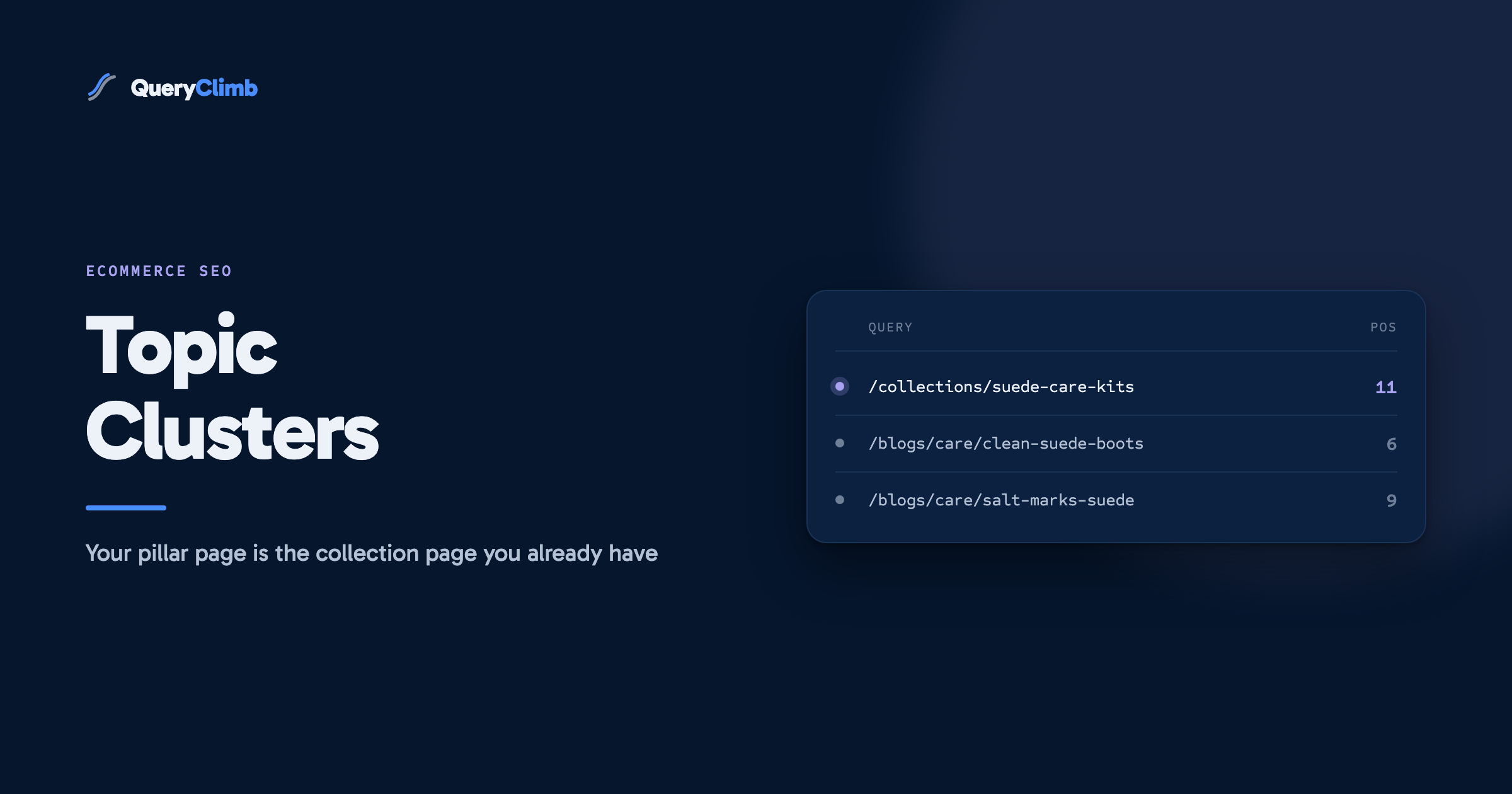
Because the money page sits inside the cluster. On a content site the pillar is an article and every link in the group is editorial. On a store, the most valuable page in a suede care cluster is /collections/suede-care-kits, and that page is chasing commercial queries at the same moment your articles chase informational ones.
Three consequences follow, and they are the whole difference:
- The pillar is often a collection page, not an article. If your collection page already ranks for “suede care kit”, it is your pillar. A 3,000-word guide on the same intent gives Google two candidates from one domain, and the article usually wins because it looks more like content, which is the wrong outcome.
- The spokes exist to feed the collection page. An article on removing salt marks from suede is worth writing because it catches a searcher with a real problem and hands them the collection page. Its ranking is a means. The collection page’s ranking is the point.
- Product pages are cluster members too. A cleaning brush product page is a legitimate link target from three different spokes. Most cluster diagrams have no box for it, which is why most store clusters leave product pages orphaned.
Once you see the collection page as the pillar, the awkward question in every cluster guide answers itself. You are not deciding whether to write a pillar, you are deciding what the existing one needs around it.
Which cluster should you build first?
The one your store already half-ranks for. Open Search Console, filter to queries at position 5 to 20 with meaningful impressions, and look for a cluster of related queries where your ranking pages are the wrong tool for the job. Our walkthrough of the striking distance report covers the filters and the prioritisation.
What you are hunting for is a theme, not a query. Ten related queries at position 8 to 16, all about caring for suede, with your collection page or a product page ranking for the informational ones, is Google telling you it wants a group of articles from you on that subject and has not found them. That is a cluster brief written by your own data.
The alternative is picking the theme you find most interesting. On our own store, the interesting themes and the ones with demand overlapped less than half the time, and both cost the same to write.
Then two tests before you commit. Does the theme connect to something you sell, within two clicks? A cluster on the history of leather tanning may rank and will not sell a single brush. And can you say something a content farm cannot? If your answer matches everyone else’s, you are competing on domain authority alone, which a young store loses.
What belongs on the pillar page, and what belongs on a spoke?
The pillar answers the broad query well enough that a reader who only reads that page leaves satisfied, and links out to the spokes for anyone who wants more on one part. The spoke answers one question completely and links back up.
For a collection page acting as pillar, that means real copy around the product grid: what the category is for, how to choose between the options, the questions buyers ask before spending. Not 2,000 words. Enough that the page has something to be relevant about. Our guide to collection page copy covers the most neglected page type on a store.
The split that works is intent. Commercial and comparison intent belongs on the pillar, because that is the page that converts. Problem-solving and how-to intent belongs on spokes, because those searchers are not buying yet and a product grid does not answer them. “Best suede protector spray” is pillar territory. “Will suede protector darken the colour” is a spoke, and the kind of question AI answer engines quote because it has a direct answer.
What the data showed us
On Supplements Wise, our own store, 88 per cent of search clicks over a six-month window came from 147 blog articles rather than from product or collection pages, while the articles that converted were the ones wired into a category we actually sold. Volume came from the spokes. Revenue came from where the spokes pointed.
How do you wire a cluster so it is actually a cluster?
A folder of related posts with no links between them is not a cluster, it is a folder. The wiring is the part that gets skipped, and it is free.
Every spoke links up to the pillar once, early, in a sentence that would exist anyway, with anchor text describing the pillar rather than saying “read more”. The pillar links down to every spoke in context, not as a list of related posts at the bottom, which readers and crawlers both discount. Spokes link sideways to the siblings a reader would want next, and every spoke links to at least one product where the recommendation is honest.
Then the maintenance nobody does. When you add the eighth spoke, the pillar and the seven existing spokes need updating to point at it, or the new post lands as an orphan in the group meant to support it. That is the job our internal linking feature exists to do, and it is also fifteen minutes of manual work per publish if you keep a list. The failure is not difficulty, it is that the work falls after the satisfying part of publishing is over. Our longer piece on internal linking for stores covers the orphan audit and the anchor rules.
How do you stop a cluster from cannibalising your own collection page?
Check before you write, not after you publish. For every planned spoke, search site:yourstore.com plus the target query and run it through your store’s own search. If a collection or product page already ranks, writing the post is not one of your options. Fold the answer into the existing page as a section, retarget the spoke to a narrower question that page does not answer, or drop it. The Shopify-specific version of this problem, and the fix when it has already happened, is in our cannibalisation guide.
The trap specific to clusters is that they are built to cover a subject thoroughly, and thoroughness is what produces two pages on nearly the same thing. “How to clean suede boots” and “how to clean suede shoes” look like two topics in a planning document. They are one query with two phrasings, and publishing both means neither ranks. Merge them, keep the phrasing with more volume, spend the saved post elsewhere.
How long does a cluster take, and how do you know it is working?
Individual spokes settle in four to eight weeks. The cluster effect, where the pillar climbs because the spokes exist and the spokes climb because the pillar does, takes longer, and on our own store it arrived as a slope change rather than a jump. Expect one to two quarters before the group behaves differently from the sum of its parts, longer on a domain registered this year.
Measure the group, not the posts. Track the pillar’s position for its commercial query, total clicks across every URL in the cluster, and whether the pillar moved after each spoke landed. Spokes ranking while the pillar sits still for four months means the links are not doing their job, or the spokes answer questions unrelated to what the pillar sells. The six-month arc on our own store is this with dates and caveats attached, including the parts that were probably not the tooling.
What automation changes, and what it does not
Everything above works with Search Console, a spreadsheet and a habit, which is how we ran it before there was a product. What software removes is the tedious middle: pulling the query list, spotting which queries group into a theme, checking each planned post against every existing page, and keeping links wired as the cluster grows.
That is what QueryClimb does, through Search Insights for theme detection, the Content Calendar for sequencing a cluster across a month, and the Blog Writer for drafting against a brief rather than a keyword. The free audit runs the first part on your own data, so you can see which cluster your store already half-ranks for before paying for anything.
What it does not change: whether a cluster is worth building at all, which category deserves the next quarter, and when to stop adding spokes to a subject you have covered. Those are merchandising decisions wearing an SEO hat, and no tool has the context to make them.
Key takeaway
On a store, the pillar is usually the collection page you already have. The job is not writing a big guide, it is building the group of articles that feed the page that takes the money.
Frequently asked questions
How many posts should a topic cluster have?
As many as there are questions with real demand behind them, usually four to eight rather than the twenty cluster templates suggest. Count the genuinely distinct queries in your Search Console data, then write that many. Padding with near-duplicate phrasings is how stores end up with pages splitting each other’s rankings.
Should the pillar page be a blog post or a collection page?
A collection page whenever the broad query has commercial intent, which for most store categories it does. Someone searching “suede care kit” wants to buy one. If you make an article the pillar for that query, you are ranking the page that cannot sell over the page that can. Use an article as the pillar only when the broad query is genuinely informational and no page in your catalogue matches it.
Do topic clusters still work now that AI answers questions directly?
The spokes work harder than before, because a page that answers one question directly under a clear heading is the shape ChatGPT, Perplexity and Google’s AI Overviews quote. What has weakened is the sprawling 4,000-word pillar written to cover everything. Our guide to getting cited by AI search covers what those systems pull.
How do I know if my cluster is cannibalising itself?
Search Console, Performance report, filter by the query, then look at the Pages tab. If two of your URLs both show impressions for the same query and neither is in the top five, they are splitting it. The one with more impressions usually deserves to survive, and the other should be merged into it and redirected.
Can I build a cluster around a product I only just launched?
You can, and it will be slower than one built around a category you already rank in. A new product has no query history, so you are guessing at demand rather than reading it. If the launch matters commercially, build it anyway and accept the timeline. If it does not, build where your data says Google already thinks you are relevant, and come back once the category has authority to lend.